Is Your Food Actually Organic? FSSAI Gives Tips
Is your food truly organic? FSSAI has issued a new guide to help consumers spot genuine organic products. To ensure authenticity, shoppers should look for the unified 'Jaivik Bharat' logo alongside NPOP or PGS-India marks. Genuine products must also feature a valid license number or QR code for traceability. Don't rely on 'natural' claims, verify the label to ensure food safety and quality.

As consumer interest in natural produce grows, so does the risk of misleading labels. To help shoppers navigate the aisles with confidence, the Food Safety and Standards Authority of India (FSSAI) has released a new guide on how to verify the authenticity of organic products. By focusing on specific "trust marks," the regulator aims to ensure that consumers are paying for genuine organic practices rather than just clever marketing.
The initiative follows increasing concerns over "greenwashing," where products are labeled as "natural" or "chemical-free" without meeting rigorous certification standards. FSSAI’s latest advisory emphasises that "organic" is a regulated term in India, requiring specific logos and certification numbers that allow for digital traceability from the farm to the retail shelf.
How To Verify Organic Food in India
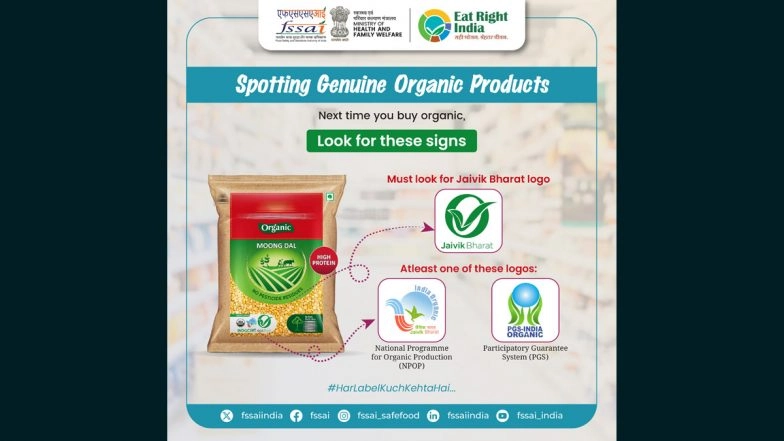
The primary indicator of a genuine organic product in India is the Jaivik Bharat logo. This unified identity mark features a green checkmark nestled within a leaf, symbolising nature and holistic health. FSSAI mandates that any product sold as organic must carry this logo, which serves as a government-backed guarantee that the food was produced without synthetic fertilisers or pesticides.
Dual Certification Systems
Beyond the Jaivik Bharat mark, authentic products must display one of two specific certification logos depending on how they were sourced:
- NPOP (National Programme for Organic Production): This logo is typically found on commercially processed or exported organic goods and is managed by the Ministry of Commerce.
- PGS-India (Participatory Guarantee System): This mark is often seen on produce from local farmer groups and small-scale cooperatives.
Digital Verification and Traceability
Expert advice from FSSAI suggests that looking for the logo is only the first step. Genuine packaging will also include a license or registration number and, in many cases, a QR code. Consumers can scan these codes or enter the certification number into the Indian Organic Integrity Database to verify the producer’s details and the product’s journey.
In India, for a product to be labeled as "Certified Organic," at least 95% of its ingredients must meet organic standards. Without these official marks, terms like "farm-fresh" or "eco-friendly" are largely unregulated and do not guarantee organic integrity. By checking for the FSSAI-approved logos, shoppers can protect themselves from fraud and support farmers who adhere to strict biodiversity and soil health standards.
(The above story first appeared on LatestLY on Apr 20, 2026 09:10 PM IST. For more news and updates on politics, world, sports, entertainment and lifestyle, log on to our website latestly.com).