Why Cooper Connolly Should Have Been Not Out Despite Khawaja Nafay's Stumping
Pakistan wicketkeeper Khawaja Nafay has sparked debate following a controversial stumping of Australia’s Cooper Connolly during the third T20I in Lahore. While the dismissal was upheld on the field, TV replays suggest a technical breach of ICC regulations regarding how a wicket is "fairly broken".

Pakistan’s dominant 3-0 T20I series sweep over Australia has been clouded by a significant umpiring controversy during the final match at the Gaddafi Stadium. Wicketkeeper Khawaja Nafay, standing in as the primary gloveman ahead of the T20 World Cup, successfully appealed for a stumping against Australia’s Cooper Connolly, but subsequent replays suggest the dismissal should have been overturned. Pakistan T20 World Cup 2026 Jersey Revealed, New Kit Based on 'Vanguard Markhor' Design.
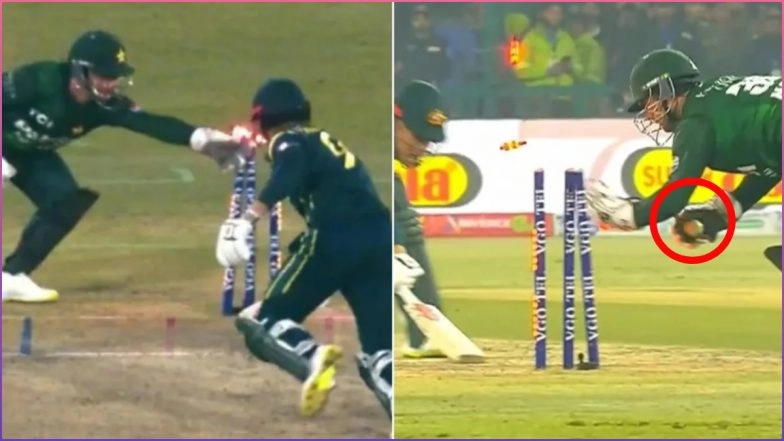
The incident occurred in the 14th over of Australia's chase, with the visitors already reeling at 82-6. Connolly, attempting to attack spinner Mohammad Nawaz, stepped out of his crease and was beaten by the turn. Nafay collected the ball and dislodged the bails with Connolly well short of the crease. However, a broadcast footage quickly highlighted a technical error that has since gone viral on social media.
The 'Wrong Hand' Infringement
Television replays showed that while Nafay collected the ball cleanly in his right glove, he appeared to dislodge the bails using his empty left hand. Under the standard laws of cricket, this is considered an invalid method of breaking the wicket. Pakistan Boycotts T20 World Cup 2026 Match Against India: What It Means.
The on-field umpires, however, ruled the batter out without a comprehensive review of the hand used to break the stumps. The dismissal contributed to Australia being bowled out for just 96, marking their heaviest-ever defeat in T20 international cricket by a margin of 111 runs.
Khawaja Nafay Stumping Video
Pakistan just invented a new law for wicketkeeping 😭😭
Pak keeper Khawaja Nafay held the ball in his right hand and stumped with his left hand. Absolute jokers🤣pic.twitter.com/fC2QYks16y
— Suprvirat (@Mostlykohli) February 2, 2026
What Stumping Laws of Cricket Say
The controversy centres on Clause 29.2.1 of the ICC Men’s T20I Playing Conditions (and Law 29 of the MCC Laws of Cricket), which defines how a wicket is fairly broken.
According to the regulations, a wicket is broken fairly only if:
1. The ball is held in the hand or hands used to remove the bails.
2. The ball is held in the hand of the arm used to dislodge the stumps.
Because Nafay held the ball in his right hand but removed the bails with his left, the "ball-in-hand" requirement was not met. Had the third umpire intervened or the on-field officials spotted the discrepancy, Connolly would have been ruled not out.
The incident has placed Khawaja Nafay under the spotlight just days before the 2026 T20 World Cup. While Nafay is primarily known as an explosive middle-order batter, his role as a backup wicketkeeper is now under technical scrutiny.
(The above story first appeared on LatestLY on Feb 02, 2026 08:11 PM IST. For more news and updates on politics, world, sports, entertainment and lifestyle, log on to our website latestly.com).