Annular Solar Eclipse 2026 Date and Time: Will ‘Ring of Fire’ Be Visible From India?
The 'Ring of Fire' annular solar eclipse will occur on February 17, 2026. While it begins at 12:31 PM IST, it will not be visible from India, as the path is limited to Antarctica and the Southern Hemisphere. Enthusiasts in India can watch the event via NASA’s live stream. The next total solar eclipse is slated for August 12, 2026.

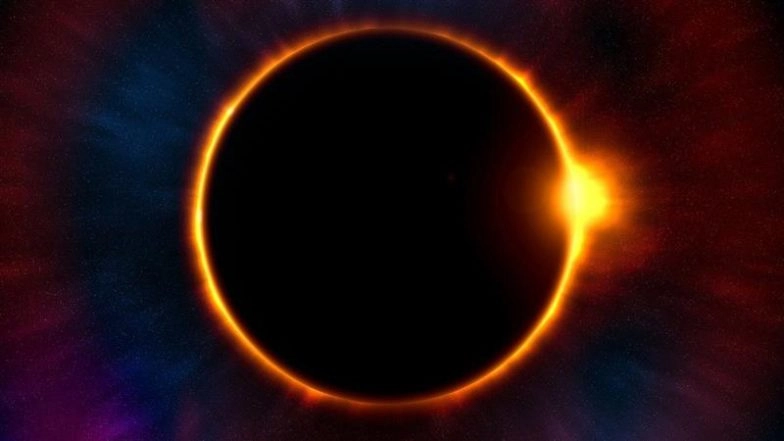
Mumbai, February 11: The first major celestial event of the year, an annular solar eclipse popularly known as the "Ring of Fire," is set to take place on Tuesday, February 17, 2026. During this rare astronomical phenomenon, the Moon will align between the Earth and the Sun while at its farthest point from our planet. Because the Moon will appear slightly smaller than the Sun, it will not fully cover the solar disk, leaving a brilliant, fiery outer ring visible in the sky. While the event is generating significant global interest, astronomers confirm that the "Ring of Fire" will not be visible from India.
The eclipse is scheduled to begin at approximately 12:31 PM IST (07:01 UTC) and will reach its maximum point at 5:42 PM IST. However, because the path of annularity, the specific corridor where the full "ring" effect is visible, is located almost exclusively over Antarctica and the remote Southern Ocean, observers in the Northern Hemisphere will miss the display entirely. For India, the Sun will either be below the horizon or the alignment will be geographically shielded, rendering the eclipse invisible across all Indian cities. 2026 Stargazing: Eclipses, Meteor Showers and Supermoons.
Annular Solar Eclipse 2026: Will ‘Ring of Fire’ Be Visible in India?
No, the annular solar eclipse will not be visible from India. The event is expected to go completely unseen across most of Asia, including India. So unfortunately, there will be no partial or full phases visible in the country this time.
Where the 'Ring of Fire' Will Be Visible
The full annular effect will be a secluded event, primarily witnessed from scientific research stations in Antarctica, such as the French-Italian Concordia Station and Russia’s Mirny Station. In these locations, the "Ring of Fire" is expected to last for approximately 2 minutes and 20 seconds. NASA Sets SpaceX Crew-12 Mission Launch for February 11: From Crew to Mission Objectives and Live Coverage, All You Need To Know.
Beyond Antarctica, a partial solar eclipse will be visible in several other regions, including:
- Southern Africa: Parts of South Africa (Cape Town and Durban), Namibia, and Zimbabwe.
- South America: Southern tips of Argentina and Chile.
- Islands: Mauritius, Madagascar, and the French Southern Territories.
Understanding the 'Ring of Fire' Phenomenon
An annular solar eclipse differs from a total solar eclipse due to the distance of the Moon from Earth. When the Moon is near its apogee (farthest point), its apparent size is insufficient to block the entire Sun.
Instead of the midday darkness associated with a total eclipse, the sky dims significantly, and the Sun's light is reduced to a thin, luminous halo. Scientists estimate that during this February 17 event, the Moon will cover roughly 96% of the Sun's center.
Safety and Online Viewing for India
Although the eclipse is invisible from India, safety remains a priority for those in the visibility zones. Experts stress that an annular eclipse is never safe to view with the naked eye, as the "Ring of Fire" still emits enough intense solar radiation to cause permanent retinal damage. ISO-certified eclipse glasses are mandatory for direct observation.
For enthusiasts in India wishing to experience the event, several international space agencies, including NASA and various astronomical observatories, will provide high-definition live streams. These digital broadcasts offer a safe and clear way to witness the celestial display from the comfort of home.
(The above story first appeared on LatestLY on Feb 11, 2026 04:36 PM IST. For more news and updates on politics, world, sports, entertainment and lifestyle, log on to our website latestly.com).