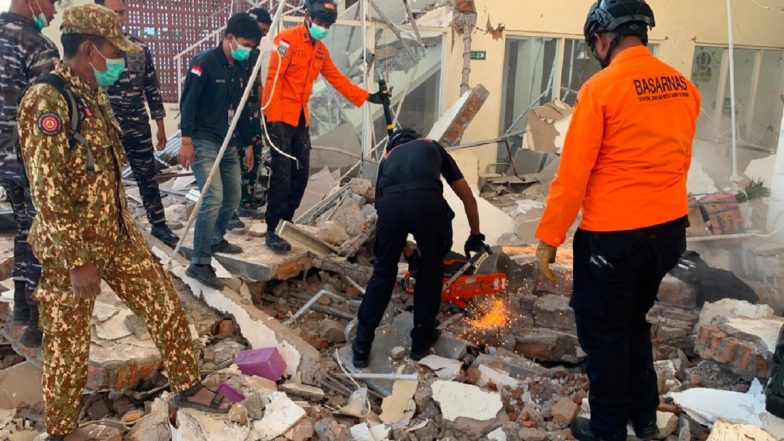
Earthquakes in Delhi-NCR Are Due to Release of Strain Energy; What Is Strain Energy? Here’s All You Need to Know
All the earthquakes in Delhi-NCR are due to the release of strain energy, indicating that strain energy is built up in the region. The strain energy has been accumulated as a result of the collision of the Indian plate with the Eurasian plate, through the fault or weak zones.

The Delhi-NCR region has been witnessing a rise in the number of earthquakes over the past few months. According to reports, from April 12 to June 8 this year, the National Centre for Seismology (NCS) has recorded a total of 12 earthquakes in Delhi-NCR. The most number of quakes this year have been reported in the month of May. A study by the Wadia Institute of Himalayan Geology (WIHG), an autonomous institute of the Department of Science and Technology, stated that all the earthquakes in Delhi-NCR are due to the release of strain energy, indicating that the energy has been built up in the region, triggering frequent quakes. The strain energy has been accumulated as a result of the collision of the Indian plate with the Eurasian plate, through the fault or weak zones.
The Delhi-NCR has been identified as the second highest seismic hazard zone (Zone IV). For the residents in the national capital territory, earthquakes have become a regular phenomenon as the region has been witnessing jolts ranging in two to three magnitude on a usual basis. The study said that the recent Delhi-NCR tremors do not signal of a big event, though a strong earthquake cannot be ruled out. “All the earthquakes in Delhi-NCR are due to the release of strain energy, which have been accumulated as a result of northward movement of Indian plate and its collision with the Eurasian plate, through the fault or weak zones”, the WHIG study stated.
What is Strain Energy:
The strain energy, as potential energy, released by an earthquake and the seismic moment are two fundamental physical earthquake parameters. An earthquakes occurs when energy stored in elastically strained rocks is suddenly released. This release of energy causes intense ground shaking in the area near the source of the earthquake. The energy sends waves of elastic energy, called seismic waves, throughout the Earth, thus making people the tremors.
How does an Earthquake Occur
When an earthquake occurs, the stress that has been accumulated in solid rocks within the Earth, is suddenly released along fault lines and weak zones. Inside the earth, rocks are constantly subjected to forces which tend to bend, twist, or fracture them. The Earth's crust is constantly subjected to forces which causes rocks to bend, twist or fracture. These forces are called stress. In response to stress, the rocks within the Earth's crust undergo strain, also known as deformation. A Strain is therefore, any change in volume or shape.
The Delhi-NCR has been identified as the second highest seismic hazard zone (Zone IV). The study revealed that out of 14 small magnitude earthquakes in the Delhi-NCR, the 29th May Rohtak earthquake had the magnitude of 4.6. It added saying that the recent events cannot be defined as the ‘foreshocks’.
Foreshock: What Does it Mean
If a big earthquake takes place in a region, all smaller events that occurred in the immediate past at that region are categorized as the foreshocks. Scientifically, all these tremors in the Delhi-NCR can be demarcated as the foreshocks only after a big earthquake takes place immediately. In other words, a foreshock is an earthquake that occurs before a larger seismic event (the mainshock). An earthquake is called as foreshock, mainshock or aftershock is only after the full sequence of events has happened.
Past Earthquakes Scenario In Delhi-NCR:
The historical earthquake catalog shows that there were strong earthquakes of 6.5 magnitude at Delhi in the year 1720; 6.8 at Mathura in the year 1803; 5.5 near Mathura in the year 1842; 6.7 near Bulandshahar in 1956; 6.0 near Faridabad in 1960; 5.8 near Moradabad in 1966 in the Delhi-NCR.
Reason of Earthquakes in Delhi-NCR
All the earthquakes in the Delhi-NCR are due to the release of strain energy and after the Indian plate collides with the Eurasian plate, through the fault or weak zones. There are so many weak zones and faults in the Delhi-NCR. In Delhi, the weak zones are Delhi-Haridwar ridge, Mahendragarh-Dehradun subsurface fault, Moradabad fault, Sohna fault, Great boundary fault, Delhi-Sargodha ridge, Yamuna river lineament, Ganga river lineament etc.
Indian Plate and Eurasian Plate
As per reports, around 140 million years ago the main landmass on Earth was concentrated together in a super continent called 'Gondwana'. This continent started to break up in four tectonic plates; African, Antarctic, Australian and Indian plates. The Indian plate is a major tectonic plate straddling the equator in the eastern hemisphere. It is bounded by 4 major tectonic plates, to the North of the Indian plate is the Eurasian plate and to the south east is the Australian plate,. To the south west of the Indian Plate is the African plate and to the west the Arabian plate.
The Collision of Indian Plate and Eurasian Plate
The collision of the Indian plate and the Eurasian plate happened in the Himalayan seismic belt which caused the accumulation of strain energy. The strain energy is accumulated at the plate boundary due to relative movement of plates against each other causing crustal shortening and deformation of rocks. This energy can be released through the weak zones and faults in the form of earthquakes ranging from micro (<3.0), minor (3.0-3.9), light (4.0-4.9), moderate (5.0-5.9), strong (6.0-6.9), major (7.0-7.9) or great (>8.0) earthquake, defined as per the amount of energy released.
Earthquakes are not predictable but there is a probability of a large quake with magnitude 6 or more in the highest seismic potential zone V and IV, which comes under the entire Himalaya and Delhi-NCR. The only solution to minimise the loss of lives and property is the effective preparedness against the earthquake.
(The above story first appeared on LatestLY on Jun 19, 2020 01:59 PM IST. For more news and updates on politics, world, sports, entertainment and lifestyle, log on to our website latestly.com).