Lunar Eclipse March 2026: Date, Time and Will It Be Visible in India?
A total lunar eclipse, or Blood Moon, will occur on Tuesday, March 3. While totality will be visible in the Americas and East Asia, India will only see the concluding partial phases during moonrise. Totality ends around 5:25 PM IST, so eastern regions like Kolkata have the best view, while western cities may miss the red hue.

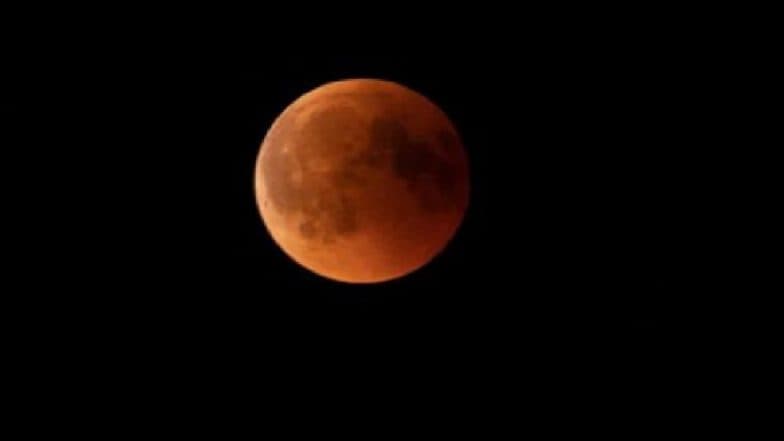
Mumbai, February 26: Skywatchers are preparing for a major celestial event as a total lunar eclipse (Chandra Grahan), often referred to as a "Blood Moon", is set to occur on Tuesday, March 3. While the eclipse will be a dramatic spectacle for much of the world, its visibility in India will be highly dependent on regional moonrise timings, with eastern parts of the country having the best vantage point. The event marks the first of two lunar eclipses scheduled for 2026, occurring when the Earth passes directly between the Sun and the Moon, casting its deep shadow across the lunar surface.
Key Timings and the 'Blood Moon' Phase on Lunar Eclipse 2026
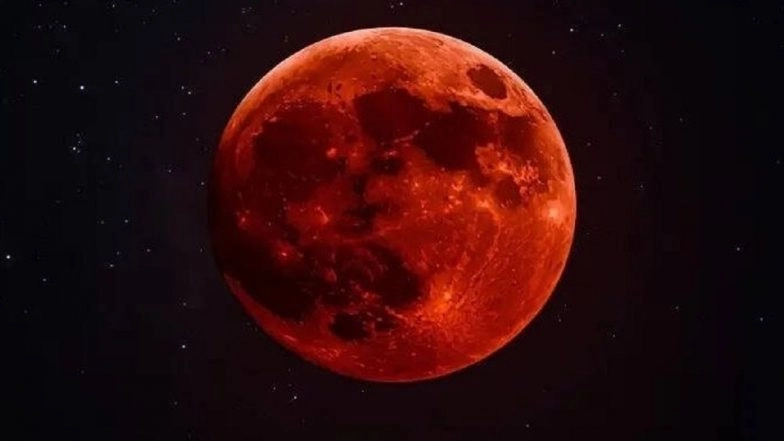
The eclipse will progress through several stages, beginning with the penumbral phase and culminating in "totality", where the Moon takes on a reddish-copper hue. This colouration is caused by Earth's atmosphere scattering shorter wavelengths of light and refracting longer, red wavelengths toward the Moon. Chandra Grahan on Holi 2026: India Visibility of Lunar Eclipse, Timings, Sutak Kaal, and Impact on Holika Dahan.
According to astronomical data, the key global phases of the eclipse are:
-
Partial Eclipse Begins: 2:51 PM IST
-
Total Eclipse (Totality) Begins: 4:01 PM IST
-
Maximum Eclipse: 4:43 PM IST
-
Totality Ends: 5:25 PM IST
-
Partial Eclipse Ends: 6:35 PM IST
Will the Lunar Eclipse Be Visible in India?
In India, the visibility of the eclipse is limited because the majority of the total phase occurs while the Moon is still below the horizon. As a result, most of the country will only witness the final stages of the partial eclipse during the moonrise in the evening.
Eastern India: Cities like Kolkata, Guwahati, and Itanagar will have the clearest view. In these regions, the Moon will rise just as the total phase is ending or during the subsequent partial phase, allowing observers to see the shadow receding.
Central and Western India: In cities like Delhi, Mumbai, and Bengaluru, the Moon will rise even later. Residents in these areas will largely miss the red "Blood Moon" phase and may only witness the very end of the penumbral eclipse, which appears as a subtle shading on the Moon's surface. Holi Grahan 2026: Did You Know It is a Rare Hat-trick of Holi and Lunar Eclipse This Year?
Sutak Kaal and Cultural Observations
For many in India, lunar eclipses carry religious and cultural significance. The Sutak Kaal, a period of abstinence observed before an eclipse, typically begins nine hours before the start of a lunar eclipse. However, many scholars and astronomers note that the Sutak and other traditional restrictions are generally considered applicable only in regions where the eclipse is physically visible to the naked eye. Since the total phase is not visible across most of India, temple schedules and rituals may vary by region.
How to Watch the Lunar Eclipse (Chandra Grahan) on March 3
Unlike solar eclipses, a lunar eclipse is completely safe to view without specialised eye protection. No filters or solar glasses are required. To get the best view, astronomers recommend finding a location with an unobstructed view of the eastern horizon. While the event can be seen with the naked eye, using a pair of binoculars or a small telescope can help observers see the details of the Earth's shadow moving across the lunar craters.
(The above story first appeared on LatestLY on Feb 26, 2026 03:17 PM IST. For more news and updates on politics, world, sports, entertainment and lifestyle, log on to our website latestly.com).