













 Quickly
 Socially
 Trending
 Crypto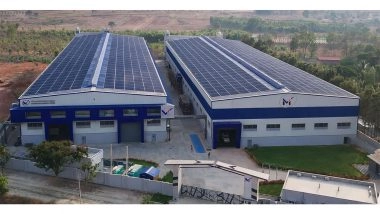
New Delhi [India], January 5 (ANI): As global manufacturing shifts decisively toward low-carbon, high-efficiency production, sheet metal cold-roll forming is emerging as a highly effective method for reducing process embedded carbon emissions. With India accelerating its climate commitments under National Resource Efficiency and Circular Economy frameworks, industry leaders are advocating for policy recognition of sheet metal cold-roll forming as a carbon-efficient manufacturing process eligible for green credits.
Precision cold-roll forming differs fundamentally from conventional fabrication methods such as stamping, machining, or laser cutting. Unlike these techniques, where Forming shapes components directly, inherently generating metal scrap and consuming higher process energy, cold roll forming shapes components from sheet metal with minimum scrap. This also results in superior dimensional accuracy, higher structural strength, and significantly lower lifecycle emissions.
Santosh Venkatasubbaiah, Director - Sales & Marketing at Mother India Forming, explains - "Sheet metal cold-roll forming eliminates scrap at the source and reduces process energy. Any process that prevents waste before it is created strengthens India's sustainability goals and deserves formal recognition within the national carbon-efficiency framework."
Highlighting the process embedded carbon advantage, he added, "When industries adopt cold-roll forming, their final products carry measurably lower carbon footprints. This also aligns perfectly with the criteria for green-credit eligibility based on efficiency and lifecycle impact."
According to company information, Mother India Forming has developed a fully integrated, 360-degree manufacturing ecosystem where sheet metal cold-roll forming, fabrication, finishing, and powder coating all operate under one roof. This consolidation drastically reduces multi-vendor logistics and associated Scope-3 emissions for primary equipment manufacturers. The company is also expanding its renewable energy capacity from 150 KW to 5 MW of solar power, complementing its already low-carbon operational model.
Global industry outlooks project a 7-9% compound annual growth rate in demand for precision-formed components through 2030. Growth is being driven by sectors such as automotive and electric vehicles, renewable energy, infrastructure, engineered structures, warehousing systems, construction frameworks, and electrical equipment--industries increasingly requiring lightweight, high-strength, dimensionally stable components with low environmental impact.
While no consulting firm or research institute has explicitly declared that "sheet metal cold-roll precision-formed components generate carbon credits," organisations such as Deloitte, PwC, EY, Accenture, and The Energy and Resources Institute (TERI) define frameworks under which measurable improvements--waste reduction, energy efficiency, and renewable power adoption--can be converted into verifiable carbon credits. With a robust Life Cycle Assessment (LCA) and a comprehensive Measurement, Reporting, and Verification (MRV) process, sheet metal cold-roll forming can align with global carbon accounting methodologies.
"India has a global opportunity," Santosh emphasises. "Recognising sheet metal cold-roll forming under the Green Credit Programme will boost the Prime Minister's Made in India mission by enabling world-class, resource-efficient manufacturing. Policy recognition will give Indian industry a measurable carbon advantage and position the country as a sustainable manufacturing hub. This will also encourage global OEMs to look towards India for manufacturing."
The steel sector alone accounts for 10-12% of India's total emissions, making its decarbonisation crucial to national climate goals. The Ministry of Steel has constituted 14 task forces focusing on green steel, decarbonisation levers, and supporting India's transition to low-carbon manufacturing.
As industries face rising pressure to decarbonise supply chains, sheet metal cold-roll precision forming offers India a ready, scalable, and technologically proven pathway to achieve low-carbon manufacturing leadership. (ANI)
(The above story is verified and authored by ANI staff, ANI is South Asia's leading multimedia news agency with over 100 bureaus in India, South Asia and across the globe. ANI brings the latest news on Politics and Current Affairs in India & around the World, Sports, Health, Fitness, Entertainment, & News. The views appearing in the above post do not reflect the opinions of LatestLY)
 Share Now
 Google Trends



 Live Bot