Do Countries Really Need Fossil Fuels to Develop?
Rich nations built their wealth on coal, oil and gas.

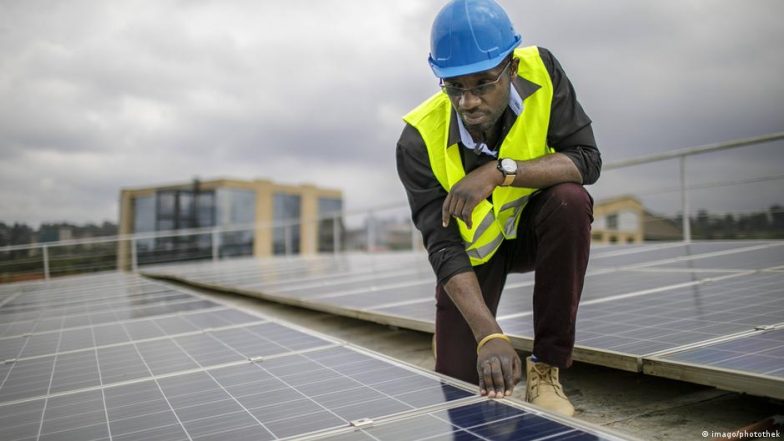
Rich nations built their wealth on coal, oil and gas. Now the world is asking poorer countries to chart a different course. Is a fossil-free path to development realistic?Mozambique is at a crossroads. On its northern coast, billions of dollars' worth of offshore gas projects could bring significant new revenue. At the same time, the country is a hydro powerhouse with huge untapped solar and wind potential.
"These are some of the most interesting cases because there are no sunk costs yet. You could still go in different directions," said Philipp Trotter, professor in sustainability management at the University of Wuppertal in Germany.
As global pressure mounts to move away from new fossil fuel development, the dilemma sharpens a long-running debate: Must poorer countries burn fossil fuels to prosper — or can they leapfrog straight to clean energy?
More profit from fossil fuels?
For decades, industrialized nations built their wealth on burning coal, oil and gas, producing a disproportionately large share of global emissions in the process. Historically, the United States, the European Union and China have been the world's largest polluters, according to the Global Carbon Budget.
Many energy leaders in Africa and Asia argue it is unfair to deny today's developing economies the same route to growth. But with greenhouse gas emissions at a record high and warming accelerating, climate scientists warn that the planet no longer has the carbon budget for everyone to follow that path.
"From a moral perspective, it makes total sense that if anyone can use fossil fuels, it should be the poorest countries," said Trotter. "The problem with that argument is it misses the economic side of things."
There is limited research on what path would be more profitable for countries at a crossroads, like Mozambique, Senegal or Mauritania.
That means it remains uncertain whether national gas will still be as competitive in world markets by the time it's been developed years down the line. After all, major economies are aiming to drastically cut their emissions by 2050 — and analysts say demand for gas, coal and oil could peak this decade.
"So, you're kind of investing a lot of money without a competitive advantage in a market that's decreasing," Trotter said. "It could work out. It could also have extreme risk."
Kenya: A renewable powerhouse
On paper, the economics of renewables have shifted decisively. More than 90% of new clean power projects worldwide produce electricity at a lower cost than new fossil fuel plants, according to the International Renewable Energy Agency.
But low operating costs do not tell the whole story.
Building green systems still requires heavy upfront investment — for wind farms, solar parks, grids, storage and backup capacity. Costs that are often harder for developing nations to shoulder.
One place where that gamble has paid off is Kenya. The country generates almost 90% of its electricity from renewables, mostly geothermal, hydro and wind power. And it aims to reach 100% with universal access by 2030.
"Kenya has abundant geothermal energy, which is like a golden egg," said Rose M. Mutiso, a Kenyan scientist and energy expert. "But obviously the country has done a lot to develop these resources over time."
The Kenyan government began investing heavily in this "golden egg" in the 1990s and early 2000s after droughts exposed the risks of relying too heavily on hydropower. Through the state-owned Geothermal Development Company, the country used public money and development-bank loans to cover the risky early stages of tapping underground heat before private investors stepped in.
"This is not an overnight journey. This is a long, sustained process," Mutiso added.
But parts of this model could be difficult for countries like Mozambique or Senegal to replicate. Highly indebted with lower credit scores than Kenya, they might have a harder time attracting payable loans.
Different approaches for different countries
What this highlights is that one size does not fit all when it comes to energy transitions.
Researchers have found that the pathway a country can take depends on several factors: how fossil fuels are currently woven into its economy, whether they are mainly used at home or exported, and how diversified the rest of the economy already is.
That alone shows why it makes little sense to compare a country like Ethiopia, which largely electrified through cheap hydropower thanks to its river resources, with India, which depends on coal for most of its electricity and employs millions of people across this supply chain.
In India, falling wind and solar prices have actually helped drive an ambitious renewable energy program. The country ranks fourth worldwide in installed renewable power capacity.
But coal still accounts for more than 70% of its power generation. It employs relatively few people nationwide but remains the only economic activity in some districts. At the same time, energy demand is rising rapidly as industry expands and living standards improve.
That means the country is trying to manage a green and just transition while electricity consumption is climbing.
"You're asking it to do double duty. That's not as easy on an accelerated time frame," said Rahul Tongia, a senior fellow with CSEP, a public policy think tank in New Delhi.
More money from richer nations
Though developing countries face very different realities, there are some clear ways wealthier nations could help them speed up the shift to renewables.
At the top of the list is tackling one of the biggest barriers: the steep upfront cost.
"Developed countries and high emitters need to keep the accelerator pressed because their deployment of new technologies is what brings learning-curve costs down for poorer countries," said Tongia. "So let them pay the premium for new technologies."
Poorer countries and climate experts have also long argued that far more public climate finance is needed to unlock private investment. Without guarantees and risk-sharing, many clean energy projects remain too risky for banks.
"You have to make capital accessible, but you also need guarantees that lower the perceived risk," said Trotter. "This is where developed countries can act."
At the UN climate talks in 2024, governments agreed on a new climate finance goal of at least US$300 billion (about € 256 billion) per year by 2035, a figure many developing nations say still falls short of what is needed.
For Mozambique, that shortfall could be decisive. Gas rigs promise one future, while sun and wind point to another. Which path the country ultimately takes may depend on whether wealthy nations are willing to invest in a cleaner future.
Edited by: Tamsin Walker
(The above story first appeared on LatestLY on Jan 05, 2026 04:00 PM IST. For more news and updates on politics, world, sports, entertainment and lifestyle, log on to our website latestly.com).