Ethanol-Blended Petrol Policy Hearing: Supreme Court Dismisses Plea Challenging E20 Policy
The Supreme Court on Monday dismissed a plea that challenged the nationwide rollout of 20 per cent Ethanol Blended Petrol (EBP-20) and sought the option of ethanol-free petrol. A bench of Chief Justice of India BR Gavai and Justice K Vinod Chandran declined to entertain the plea filed by advocate Akshay Malhotra.

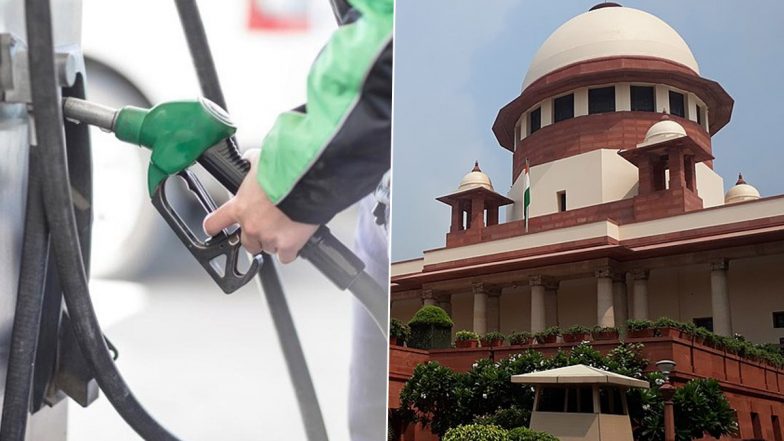
New Delhi, September 1: The Supreme Court on Monday dismissed a plea that challenged the nationwide rollout of 20 per cent Ethanol Blended Petrol (EBP-20) and sought the option of ethanol-free petrol. A bench of Chief Justice of India BR Gavai and Justice K Vinod Chandran declined to entertain the plea filed by advocate Akshay Malhotra. Attorney General for India R. Venkataramani opposed the petition, stating that everything had been considered before the rollout of the policy.
The petitioner was only a "name-lender" and there was a huge lobby, said the Attorney General. He further said that the policy was benefiting India's sugarcane farmers and was saving foreign exchange. "Will people outside the country dictate what kind of fuel India should use?" asked AG. Senior advocate Shadan Farasat, appearing for the petitioner, said that now only E20 is seemingly available without any notice, and people should be given the option of what they want. Is Ethanol-Blended Petrol Hurting Your Car? Netizens Claim Reduced Car Mileage, Express Concerns for Engine Longevity As Oil Companies Selling E20 Petrol.
He referred to a 2021 NITI Ayog Report, which he said expressed concerns about the impact of older vehicles which are not compliant with E20. He said only vehicles which are manufactured after April 2023 are compliant with E20 petrol. "We were not against Ethanol-blending, but were only seeking an option of Ethanol-free petrol for vehicles manufactured prior to 2023, which are not compatible with E20," the advocate further added. Supreme Court Dismisses PIL Seeking Ethanol-Free Petrol Option, Upholds E20 Policy.
The plea alleged that millions of motorists have been forced to use fuel not designed for their vehicles. It has sought a direction from the Ministry of Petroleum and Natural Gas to ensure the availability of ethanol-free petrol at all fuel stations. The plea further sought direction to the authorities to mandatorily label ethanol content on all petrol pumps and dispensing units, making it clearly visible to consumers, and also to ensure that consumers were informed about the ethanol compatibility of their vehicles at the time of fuel dispensing. Cars and two-wheelers manufactured before 2023, as well as some newer BS-VI models, are not compatible with such high ethanol blends, it said.
(The above story is verified and authored by ANI staff, ANI is South Asia's leading multimedia news agency with over 100 bureaus in India, South Asia and across the globe. ANI brings the latest news on Politics and Current Affairs in India & around the World, Sports, Health, Fitness, Entertainment, & News. The views appearing in the above post do not reflect the opinions of LatestLY)