How Clean Energy Could Save Us Trillions
As clean energy prices fall, a fast transition to renewable energy is the cheapest option on the table.

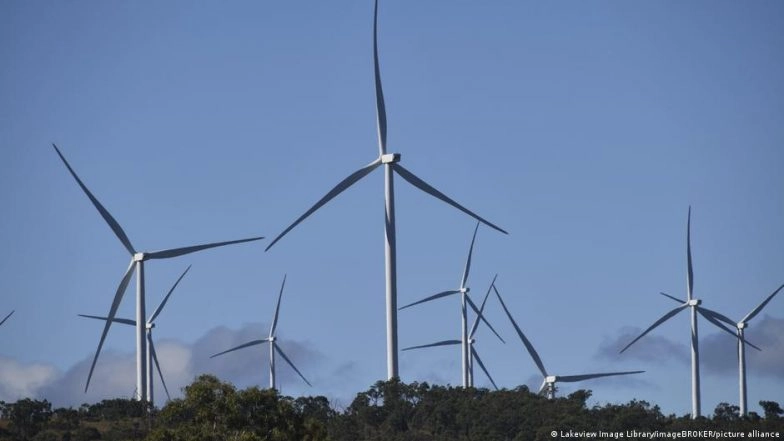
As clean energy prices fall, a fast transition to renewable energy is the cheapest option on the table. Experts say it could save us trillions in energy costs alone.In the rolling hills of southeast Queensland, Australia, farmer and businessman Brent Finlay stands beneath turbines so tall they rival skyscrapers.
Also Read | India News | Telangana HC Suspends Central Administrative Tribunal Order Quashing Appointment of BrahMos DG.
"There's a lift inside that takes about 12 minutes to go from the bottom to the top," he said, pointing skyward. Forty-five of the giant turbines that now dot his property are part of the massive MacIntyre Wind Farm which will soon generate enough electricity to power 700,000 homes.
Also Read | Business News | Nvidia Announces Full Production of Vera Rubin AI Platform with TSMC Chips.
It's a world away from the climate disaster Finlay endured five years ago when a devastating year-long drought turned his fertile land to powder, birds fell dead from the trees and thousands of native kangaroos perished from extreme temperature fluctuations.
"Our ecosystem didn't just decline, it collapsed," he recalled.
Despite experiencing firsthand the devastation climate change causes, Finlay's choice to host the wind turbines is not an environmental statement. "It's additional revenue... an investment for future generations on this farm," he told DW, pointing out that intensifying weather extremes are making farming more precarious.
Since then, he's been using regenerative farming practices to restore the wool and beef farm that's been in his family for more than 100 years. But he's also one of a growing number of farmers now allowing renewable energy projects on their land. They can earn revenue through renting land to renewable energy developers, while generating power for nearby communities.
A fast transition could save trillions
Farmers with land to rent out aren't the only ones expected to reap financial benefits from a clean energy system.
As the price of renewables technology continues to plummet, experts predict savings across the board — from lower household power prices to fewer costly climate disasters.
In fact, the quicker a transition happens, the cheaper it will be. Even without taking into account the savings to be made from avoiding costly climate disasters, aUniversity of Oxford study found a shift to renewables by 2050 could save the global economy at least $12 trillion (€10.2 trillion) in energy system costs. As compared to sticking with fossil fuels.
And those savings would be made while producing more energy overall and expanding electricity access worldwide.
The reason a rapid transition would provide more savings is because the more renewable energy technology is being made, the cheaper it's getting.
Economists describe this phenomenon as a "learning curve" called Wright's Law, which shows the costs of certain technologies fall as cumulative production increases. The same pattern drove down the price of aircraft, cars, computers, and DNA sequencing over the past century.
Prices for solar, wind, battery storage continue to fall
In the last ten years, the cost of solar panels has dropped by around 90%, largely thanks to an explosion in Chinese manufacturing capacity.
"Solar power is the cheapest form of energy in history," economist Gernot Wagner from Columbia Business School told DW. "This stuff is so cheap that Germans are installing it as garden fencing. It keeps the dog in and the car charged."
Wind power has also dropped in price by about 70% since 2014. And battery storage — vital for storing wind and solar power — is also fast improving, with prices declining by 85% compared to the 2010s.
"When you have small modular technologies, it's much easier to reduce costs because essentially you have innovation taking place over tens of thousands or even millions of different agents," Kingsmill Bond, energy strategist at the UK-based energy thinktank Ember, told DW.
Technologies vs. commodities
Compare that to the fossil fuel system, which relies on finite materials that need to be located, extracted from the ground, transported across the world, and can only be burned once.
Coal, oil and gas prices fluctuate based on geopolitics, supply shocks, and market speculation, but they do not get cheaper over time. And this price fluctuation has serious economic consequences, climate economist Wagner explained.
"That's where Putin blows a fuse, invades Ukraine... and we have the summer of 2022 when electricity prices in Europe were 10 times as high as they should have been," he said.
Solar and wind technology require upfront manufacturing and construction costs, but low operating costs. Once a solar or wind farm is built, the "fuel" — sun and wind — is free and immune to global market shocks.
According to the International Renewable Energy Agency (IRENA), in 2024, generating electricity from solar was almost half as expensive as the lowest-cost fossil alternative, and wind power was even less. As renewable capacity expands, that price difference is expected to continue growing.
Nuclear power stands out as an exception, however. Unlike solar and wind, it's not getting cheaper. A nuclear-led transition would cost around $25 trillion more by 2050 than today's energy system.
Why fossil fuels cost more than they seem
Sticking with fossil fuels might feel cheaper because the infrastructure is already built. But — even without taking into account the enormous cost of its harmful impact on the climate — running this system comes with massive ongoing operating costs.
The constant mining, transport, and machinery used to extract and refine the fuels are hugely expensive. Another hidden cost comes in the form of what economists call "rent" — the extra profit that fossil fuel-producing countries can charge for coal, oil and gas simply because they control scarce resources that are in high demand.
Saudi Arabia, for example, can extract oil for roughly $5-10 a barrel, then sell it for between $50-100. According to World Bank data, these global fossil fuel "rents" amount to as much as $2.5 trillion a year.
"We're pouring thousands of billions of dollars into the pockets of the petrostates and making them very wealthy," said energy strategist Bond. "It's that money that's up for grabs that we don't have to spend anymore."
Spending differently, not more
Contrary to popular belief, transitioning to clean energy sources like solar and wind does not require spending more overall, Bond explained. Most of the investment required can simply be reallocated from what would otherwise be spent on maintaining and expanding fossil fuel infrastructure.
"Basically, you invest to put up the clean energy system and that will save you the money that you're currently spending on buying fossil fuels," Bond said.
Money that would otherwise go toward building new pipelines, upgrading old refineries or paying for fuel imports can instead be invested in wind and solar farms, storage and grid upgrades — assets that deliver energy at far lower long-term operating costs.
"You just stick up a solar panel, and it lasts for 30 years and generates your electricity every single day... it's obviously going to be cheaper to run a renewable system," Bond told DW.
This article was adapted from an episode of DW's Living Planet podcast – "Can we afford a transition to clean energy?"with some additional updated reporting.
Edited by: Sarah Steffen
(The above story first appeared on LatestLY on Jan 07, 2026 02:30 PM IST. For more news and updates on politics, world, sports, entertainment and lifestyle, log on to our website latestly.com).