











 Quickly
 Socially
 Trending
 Crypto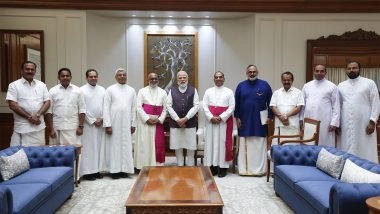
New Delhi [India], November 4 (ANI): Prime Minister Narendra Modi on Tuesday interacted with the head of the Syro-Malabar Church, Major Archbishop His Beatitude Most Rev. Mar Raphael Thattil, His Grace Archbishop Dr. Kuriakose Bharanikulangara and others.
The Prime Minister posted on X, "Had a wonderful interaction with the head of the Syro-Malabar Church, Major Archbishop His Beatitude Most Rev. Mar Raphael Thattil, His Grace Archbishop Dr. Kuriakose Bharanikulangara and others."
Also Read | Mehli Mistry Steps Down As Trustee of Tata Trusts Following Internal Rift, Recalls Commitment to Ratan Tata.
The Syro-Malabar Church, together with other Churches of St.Thomas tradition in India, traces its origin to St. Thomas, 'the apostle of India' who evangelized India in the period between 42 and 72 AD during his missionary journeys in India.
After the visit of Pantenus, the Alexandrian scholar in 189, the Indian Christians began maintaining conscious contact with the Church of the East in the Persian Empire and getting bishops sent by the Seleucian or Chaldean Patriarch throughout the medieval period. In the seventh century, metropolitan status was granted to the Indian Church which indicated the acceptance of her autonomy. The community of St. Thomas Christians maintained from that time onwards their loyalty to the Persian Church.
In the modern period, from 16 th to 19 th centuries St. Thomas Christians remained under the Portuguese Padroado and Roman Propaganda Fide jurisdictions. During this time the Church witnessed a number of changes in many respects. The oriental nature, Syriac liturgy, Indian customs and practices all underwent changes especially due to the legislations of the Synod of Diamper of 1599.
The consequent so called 'Coonan Cross Oath' of 1653 against the Portuguese ecclesiastical authorities resulted in the division of the one fold of St. Thomas Christians into different factions in the subsequent centuries. Those who remained loyal to the Roman Catholic Church were called 'the Syro-Malabar' Church and the rest accepted the Antiochean jurisdiction in the 19th century. A small faction of the Orthodox Syrian Malankara Church became Catholic in 1930 and was called 'the Syro-Malankara' Church. (ANI)
(The above story is verified and authored by ANI staff, ANI is South Asia's leading multimedia news agency with over 100 bureaus in India, South Asia and across the globe. ANI brings the latest news on Politics and Current Affairs in India & around the World, Sports, Health, Fitness, Entertainment, & News. The views appearing in the above post do not reflect the opinions of LatestLY)
 Share Now
 Google Trends



 Live Bot