










 Quickly
 Socially
 Trending
 Crypto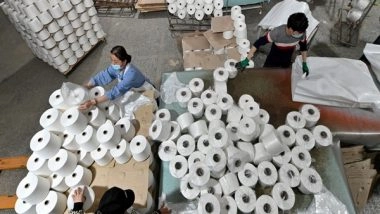
New York [US], May 17 (ANI): The US administration on Thursday added 26 textile entities like traders and warehouses to the forced labour entity list, for having an alleged link with Uyghur labour camps from China's Xinjiang, Nikkei Asia reported
This latest decision will now ban, products associated with these entities from entering the US market, the same report also claimed that this step will also increase pressure on the supply chains of the US market.
Also Read | Mehar Ashfaq Siyal Shot Dead in Pakistan: Journalist Killed by Unidentified Assailants in Punjab Province.
the US Department of Homeland Security's report stated that Companies in provinces across China, including Henan, Jiangsu, Hubei, and Fujian, have been added to the forced-labour Entity List, which now increases the count to 76 entities.
The US has repeatedly taken steps against the use of forced labour for production in China's Xinjiang region, home to the predominantly Muslim Turkic Uyghurs and other minorities.
Locals of this region have been facing human rights abuses at the hands of China however, the country denies all such claims and states that all those alleged labour programs are to alleviate poverty in the region.
The Uyghur Forced Labour Prevention Act (UFLPA) generally bars imports sourced "wholly or in part" in Xinjiang, a major cotton-supplying region. Enforcement has led to around USD 3 billion in shipments being flagged at the border since the act took effect in June 2022. Hence all the products coming from that region are considered to be a product of forced labour until there is clear evidence that proves otherwise.
The Entity List designates specific companies whose products, or components of other companies' finished products, are to be blocked from entering the country.
Authorities have flagged extra scrutiny for certain sectors, such as cotton, tomatoes, and polysilicon, a key raw material for solar panels, the report by Nikkei Asia claimed.
In the same reference the House Select Committee on the Chinese Communist Party wrote to Homeland Security Secretary Alejandro Mayorkas in January this year, urging stronger enforcement of the UFLPA through such steps as adding entities outside China to the list.
A researcher on the matter Adrian Zenz has highlighted that one key issue faced by the US government is a lack of transparency in domestic supply chains within China. According to his statement given to Nikkei Asia "The UFLPA contains a provision to monitor and keep an eye on intra-Chinese supply chains because of the risk of labour transfers to other provinces. As Xinjiang itself doesn't export so much of what is produced in Xinjiang. The greatest risk comes through intermediaries, and the Entity List is very much suited to counter or to address that problem."
Nikkei Asia further quotes the research accomplished by Zenz which stated that there was a 38 per cent increase from 2022 to 2023 in the number of labourers moved as part the "pairing assistance" program but said any future understanding of labour transfer programs could diminish now that the Chinese government has stopped publishing statistics. (ANI)
(The above story is verified and authored by ANI staff, ANI is South Asia's leading multimedia news agency with over 100 bureaus in India, South Asia and across the globe. ANI brings the latest news on Politics and Current Affairs in India & around the World, Sports, Health, Fitness, Entertainment, & News. The views appearing in the above post do not reflect the opinions of LatestLY)
 Share Now
 Google Trends



 Live Bot