‘Vladimir’ Review: Rachel Weisz Leads Netflix’s Ambitious Dramedy That Divides Critics With Its Bold Storytelling Style
Netflix’s new dramedy 'Vladimir', starring Rachel Weisz, arrives with an intriguing story and a strong cast but has left critics divided. While some praise its themes about power, desire and aging, others feel the series becomes too focused on stylistic storytelling tricks that overshadow its narrative.

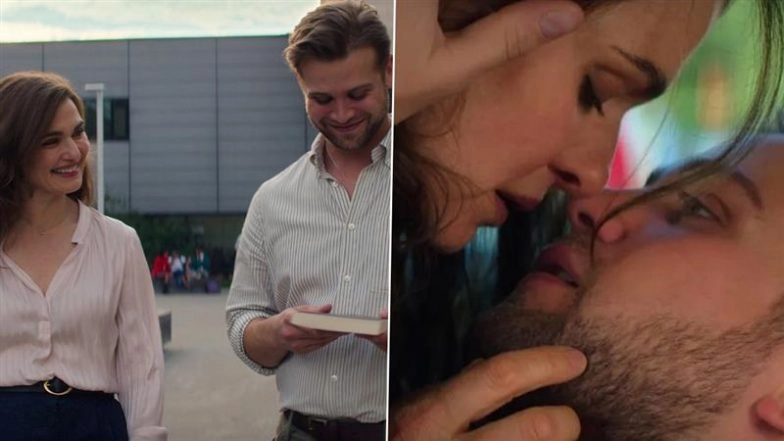
Vladimir is Netflix’s latest character-driven dramedy starring Rachel Weisz in the lead role. The show blends dark humour, psychological drama and relationship conflicts, but early reviews suggest that while the premise is compelling, the execution may not work for everyone. ‘Accused’ Netflix Movie Review: Konkona Sensharma and Pratibha Ranta’s #MeToo Thriller Receives Mixed Response From Critics.
Story and Premise
The series opens with a mysterious and unsettling scene. A woman known simply as M, played by Rachel Weisz, is seen relaxing in a quiet house in the woods while writing. Wrapped in a blanket on the couch, she suddenly turns to the camera and begins speaking about the fears and frustrations of being an “older woman.” But the calm scene quickly turns strange when viewers notice that an unconscious man is tied to a chair in the same house. When M steps outside for a cigarette, the man slowly wakes up and begins shouting, trying to understand where he is and why he has been captured. This unusual opening sets the tone for the show, which mixes personal introspection with mystery and dark humour. As the story unfolds, the narrative explores obsession, fantasy and the complicated emotional world of its central character.
A Story About Desire, Power and Identity
At its core, Vladimir tries to explore deeper themes about aging, desire and power dynamics. The protagonist struggles with feelings of invisibility and relevance as she navigates life as a middle-aged woman in a world that often celebrates youth. The show also examines fantasies, relationships and moral ambiguity. It suggests that human motives are rarely simple and that people often struggle with conflicting emotions and desires. However, while these ideas are compelling, critics say the storytelling style sometimes distracts from the emotional depth the series is trying to achieve.
Watch 'Vladimir' Trailer:
Critics Reviews
Decider: “The first episode of Vladimir left us extremely frustrated. We know there’s a good story in there somewhere, with Weisz, Woodall, Slattery, and the rest of the cast doing the best they can with the material. But the series is so in love with its stylistic touches that the story gets obliterated by them. Rachel Weisz does a fine job of communicating both of M’s sides, feeling like she’s becoming invisible as a middle-aged woman but also knowing that she’s a hell of a catch. SKIP IT. As good as Weisz and the cast of Vladimir is, they’re trapped in a story that’s smothered in gimmickry instead of character development.”
Roger Ebert: “Still, the story is driven by the Protagonist’s obsessions. She has repeated spicy fantasies about Vladimir making advances in taboo places. Yet rather than the heat of sensual allure, we feel the burn of embarrassment. It’s a secondhand kind of unease that, wherever the story is headed, it can’t be good. Yet, somehow, good is exactly where it ends. The zany, farcical, HOT MESS of the first seven episodes culminates in a satisfying eighth that’s cheeky and ultimately about reclaiming power. Not everyone will make it past the first seven, though. If you do, a wink and an arched brow will be waiting for you.”
The Guardian: “The show is interested in all of the above. Part of its power is its insistence that none of us is pure in motive, clear in our conscience, or honest with ourselves or others; nor do we treat life with the respect it deserves and the people we meet with the compassion they require. We contain multitudes, and nothing is black or white. And whatever young people think now, they will learn this too - and probably sooner than they would like.”
Variety: “Woodall, too, reads as out of place, if not as crucially. As on “The White Lotus” and “One Day,” the up-and-coming actor projects enough charm and bravado to justify his coworker’s attraction - just not the intellectualism one associates with a hot-shot scholar. Vladimir is also no boy toy. He’s married to another writer, Cynthia (Jessica Henwick), with whom he shares a three-year-old daughter. The 29-year-old Woodall slots easily into Weisz’s flagrant objectification, yet less so into the real person (who, it’s implied, is using the flirtation as an easy escape from his own complicated home life) beneath the fantasy. Though that dissonance is somewhat purposeful; it’s not like “Vladimir” is told from the perspective of someone who’s interested in Vladimir as more than a means for her own satisfaction.”
Financial Times: “In the novel Vlad is 40, so turning him into a man in his late twenties strips the story of many of its subtleties. Similarly, Weisz, while a fine actor, feels miscast as a woman who fears that she is ageing into irrelevance. She is evidently Hollywood-gorgeous, making her concerns over her growing invisibility much harder to accept at face value. Vladimir hints at meaty themes, about power, desire and women finding that they are discarded when they are no longer seen as “useful”, but it masks this intriguing discomfort with jauntiness, and in the end waves away any greater depth.”
Final Verdict
Vladimir clearly aims to tell a bold and unconventional story about power, obsession and identity. While Rachel Weisz delivers a strong performance and the themes are intriguing, critics remain divided over whether the show’s experimental storytelling enhances the narrative or overwhelms it. For viewers who enjoy unusual and character-driven dramas, the series may still be worth exploring but it may require patience to get through its more complicated storytelling style.
(The above story first appeared on LatestLY on Mar 06, 2026 11:38 AM IST. For more news and updates on politics, world, sports, entertainment and lifestyle, log on to our website latestly.com).