Davos 2026: German Chancellor Says New Era 'already Begun'
Speaking to world leaders in Davos, German Chancellor Friedrich Merz warned that "the old world order is unraveling at breathtaking pace" and set out key priorities for the future.

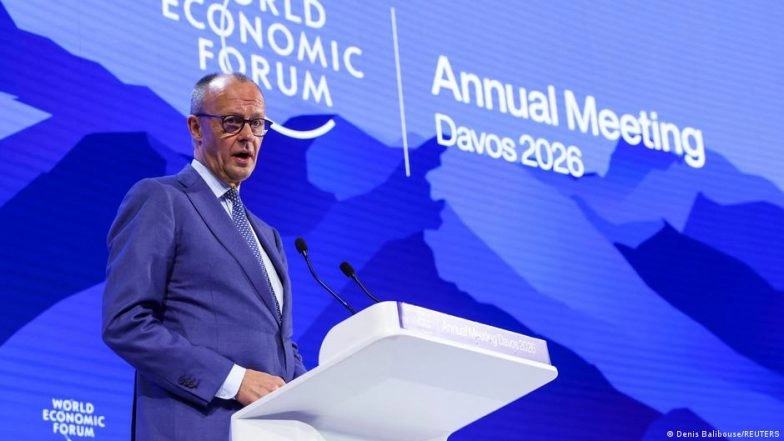
Speaking to world leaders in Davos, German Chancellor Friedrich Merz warned that "the old world order is unraveling at breathtaking pace" and set out key priorities for the future. DW has more.
Also Read | Andhra Pradesh Govt Mulls Social Media Ban for Children Below 16, Studies Australia Model.
Trump set to hold signing ceremony to launch controversial 'Board of Peace'
Also Read | Pune Grand Tour 2026: Major Traffic Diversions, Road Closures Announced in City on January 23.
The US president says he and NATO chief Rutte 'formed the framework of a future deal with respect to Greenland' while speaking in Davos
German Chancellor Friedrich Merz urges allies to stick with NATO despite 'the frustration and anger of recent months'
Below you can read up on updates from the 2026 World Economic Forum in Davos, Switzerland:
Merz on Greenland: 'NATO must do more to secure high north'
Turning to US President Donald Trump's publicly stated desire to acquire of Greenland for the United States, ostensibly for security reasons, Merz said he shared the security concerns but insisted on respecting territorial integrity.
"We welcome [the fact that] the United States is taking the threat posed by Russia in the Arctic seriously [and] we share the conviction that NATO must do more to secure the high north," he said, but insisted: "Denmark and the people of Greenland can count on our solidarity."
Merz said Germany also said he supports talks between Denmark, Greenland and the United States and welcomed President Trump's announcement last night that the US would "not use force" to acquire Greenland.
"This is the right way to go," said Merz.
Merz says Germany reducing 'dependencies'
German Chancellor Friedrich Merz has told the World Economic Forum in Davos that his country must strengthen its economic foundations.
"Germany can only lead the way in Europe if we are economically strong," he said.
Merz outlined four core priorities for the future. These include continued support for Ukraine, the need to ensure Europe is capable of self-defense, and a push to reduce economic and technological dependencies that leave the country vulnerable. He also said the economy must be able to tap its full potential for innovation and growth.
Merz also said Berlin was also focused on building "strategic coordinated ties worldwide."
"We are reducing our economic and technological dependencies," the chancellor said.
Germany's Merz urges allies to not give up on NATO
When facing a new geopolitical reality, the world, and Europe in particular, do not have to accept it as fate, according to German Chancellor Friedrich Merz.
"We have a choice," Merz said.
"Europe [and its] like-minded partners must stand closer together," he said, calling on allies not to "give up on NATO."
The chancellor also commented an increasingly volatile relationship between the United States and its European allies.
"Despite the frustration and anger of recent months, let us not be too quick to write off the transatlantic partnership," he said.
Merz: 'A new era has already begun'
German Chancellor Friedrich Merz has warned delegates at the World Economic Forum that "the old world order is unraveling at breathtaking pace" and that "a new era has begun."
Merz said that the "pole position" of the United States is being "challenged" by the emerging influence of countries like Russia and China.
"We have entered an era of great power politics," he said. "The new world of the great powers is founded upon power, strength and, when necessary, force. It is not a comfortable place."
Chancellor Merz starts Davos speech
German Chancellor Friedrich Merz, the head of the EU's richest and most populous nation, is now speaking at the Davos WEF summit.
Germany's Chancellor Merz set to give speech in Davos
German Chancellor Friedrich Merz is expected to respond to US President Donald Trump over Greenland when he addresses the World Economic Forum early on Thursday.
Merz had hoped to meet Trump for face-to-face talks on Wednesday, but these did not take place. German officials claim this was due to Trump's delayed arrival in Davos. However, the US president did find time to meet the leaders of Egypt, Switzerland and others.
Ahead of his departure to Switzerland, Merz said that Europeans wanted to respond to "such challenges" as presented by Trump in a "level-headed and appropriate" manner.
A German government spokesman said the Chancellor's visit was aimed at "building bridges with our international partners."
After his speech, Merz will also hold talks with business figures and investors "in order to promote Germany as a center for economic investment," the spokesman added.
Later on Thursday, Trump is also expected to host a form of ceremony to unveil his so-called "Board of Peace," by which point Merz will already be en route to Brussels for a European Union summit focusing on the Greenland situation.
Davos: Trump to unveil 'Board of Peace' platform for resolving conflicts
On his second day at the World Economic Forum in Davos, Switzerland, US President Donald Trump is set to host a "signing ceremony" for his so-called "Board of Peace" – his controversial international body supposedly aimed at resolving international conflicts.
Originally dreamt up to oversee reconstruction in the Gaza Strip following Israel's devastating campaign in the enclave, the board's charter sets broader goals and has sparked concerns that Trump sees it as a challenge to the United Nations.
Around 50 invitations are believed to have been extended to world leaders, about 35 of whom have reportedly agreed to join – including Israeli Prime Minister Benjamin Netanyahu and the leaders of several other Middle Eastern states such as Qatar and Saudi Arabia. The US also reportedly asked the leaders to pay $1 billion (over €855 million) to secure a permanent seat.
Trump claimed on Wednesday that Russian President Vladimir Putin, who launched his full-scale invasion of Ukraine nearly four years ago, had also agreed to join – but the Kremlin says it is still studying the invite.
"I think it's the greatest board ever formed," Trump raved on Wednesday as he met Egyptian President Abdel Fattah al-Sisi, who has also agreed to sign up.
European states such as France, Germany and the United Kingdom have expressed skepticism.
Quick recap before we resume, plus what to expect Thursday at Davos
US President Donald Trump touched on a variety of topics during a lengthy speech to government officials and business elite on Wednesday.
But he made headlines when he said he won't use military force to acquire Greenland.
Later in the day, Trump said he had a productive meeting with NATO Secretary-General Mark Rutte and that the pair had "formed the framework of a future deal" regarding Greenland.
Given that he had a deal, Trump said he was backing down from his earlier threat of imposing a 10% charge on eight European countries, including Denmark, that opposed his push to acquire the Arctic island.
On Thursday, German Chancellor Friedrich Merz is set to deliver remarks at the World Economic Forum. Plus, there are reports that Ukrainian President Volodymyr Zelenskyy may also be on his way to meet with Trump in the Swiss Alps.
We are pausing our Davos coverage
The focus of Day 3 of the World Economic Forum was on Donald Trump and his plan to take control of the Danish territory of Greenland.
It ended with an abrupt about-face by the US president, who dropped his threat to impose tariffs on several European countries, citing what he described as a new framework with NATO on Arctic security.
Earlier on Wednesday, he also ruled out the idea of taking Greenland by force.
For reactions to that and more details on what he has planned, please click here to follow our other live blog on covering Greenland.
As far as Davos is concerned, we will be back tomorrow with more coverage. Thanks for following along today.
Swedish foreign minister welcomes Trump's move away from tariffs
Swedish Foreign Minister Maria Malmer Stenergard welcomed the US president's announced withdrawal of a threat to impose new tariffs on eight European nations for their support of Greenland.
"Good that Trump has now backed away from tariffs on those of us who have supported Denmark and Greenland," she wrote on X. "The demands about moving borders has received well-earned criticism. That is also why we have repeated that we will not be blackmailed. It appears that our work together with allies has had an impact."
Trump drops tariff threat in Greenland push
President Donald Trump said he is dropping his tariff threat on several European nations after agreeing with NATO Secretary General Mark Rutte on a "framework of a future deal" involving Greenland and the wider Arctic region.
The step-down comes days after Trump threatened to impose a 10% import tariff on goods from Denmark, Norway, Sweden, France, Germany, the UK, the Netherlands and Finland until "a deal is reached for the complete and total purchase of Greenland."
On Wednesday, he wrote on Truth Social: "I will not be imposing the Tariffs that were scheduled to go into effect on February."
The move could ease tensions with NATO partners, though questions remain about what the Arctic deal actually includes.
Europe has been steadfast in saying Greenland is not for sale and cannot be wrested from Denmark.
Speaking at WEF earlier, Trump also ruled out using force to acquire the island from Denmark, calling instead for immediate negotiations.
Trump argues Greenland is vital for US and NATO security against Russia and China.
Trump says he and NATO's Rutte agreed to 'framework of a future deal' on Arctic
US President Donald Trump said he and NATO Secretary-General Mark Rutte "have formed the framework of a future deal" concerning Greenland.
The two met during the World Economic Forum.
Trump added that he would not impose tariffs on key allies, including Germany, despite their opposition to his plan for the US to take control of Greenland.
"This solution, if consummated, will be a great one for the United States of America, and all NATO Nations," he wrote on his Truth Social.
Germany's Wadephul says Trump's focus on Arctic security is 'very right'
German Foreign Minister Johann Wadephul told DW he never expected the United States would use force to annex Greenland from Denmark.
He said, however, that President Donald Trump is "very right in being focused on the security issues, we are with him, and we will find a solution in our alliance and not against each other."
"We have to encounter, of course, threats from Russia and from China," Wadephul said.
Speaking at the World Economic Forum in Davos, Trump said he "won't use force" to take control of Greenland, but he wants "immediate negotiations" over a US acquisition (see earlier entries). He insisted that the US needs ownership of the Arctic territory to ensure international security.
"Perhaps the NATO framework is the one which we should use right now," Wadephul said.
WEF attendees reacts to Trump's speech
Donald Trump's speech was one of the most anticipated on the second day of the World Economic Forum.
DW asked attendees at Davos for their reaction to the speech:
Vocal Trump critic Gavin Newsom, governor of California, said Trump's plan to take over Greenland with force was a non-starter as "there wasn't support for that back home." He said Trump's suggestion to negotiate for the US to gain control of Greenland did not amount to much since Europeans have always indicated they were "happy to negotiate."
Sweden's Deputy Prime Minister, Ebba Busch, warned that Trump still wanted Greenland. "Let's just keep our cool, things are quite heated now, this is not going to be solved this week. We are ready to hold the line, Europe needs to toughen up," she said.
Joe Kaeser, chairman of the supervisory boards of Siemens Energy and Daimler Truck Holding, said there was no "substantial news" from Trump's speech. "He is known as a person who pushes the envelope further than where he wants it to land," Kaeser said of Trump, adding that the undertaking not to use force to take Greenland was a "tactical way of pulling back."
In his speech, Trump said he would meet Zelenskyy to discuss ways to end Russia's war in Ukraine. Trump's envoys have been discussing a plan to secure a ceasefire with Russia and Ukraine. On Ukraine, Senator Lindsey Graham, a Trump ally who is also in Davos, told DW any deal would need Senate approval and strong security guarantees for Ukraine to get that. "If you do a deal on security guarantees you got to get 60 votes in the Senate, they need to be real to prevent a third invasion," he said.
IN PICTURES: Davos behind the scenes
(The above story first appeared on LatestLY on Jan 22, 2026 03:00 PM IST. For more news and updates on politics, world, sports, entertainment and lifestyle, log on to our website latestly.com).