Delhi Air Pollution: National Capital Wakes Up to Dense Smog As AQI Soars to 497, Remains in ‘Severe’ Category Despite GRAP-IV (Watch Video)
The national capital woke up to dense smog on Sunday morning as the average Air Quality Index (AQI) stood at 461 at 7 am, falling in the 'severe' category despite the Graded Response Action Plan (GRAP)-IV in effect across Delhi and the National Capital Region (NCR), according to the Central Pollution Control Board (CPCB).

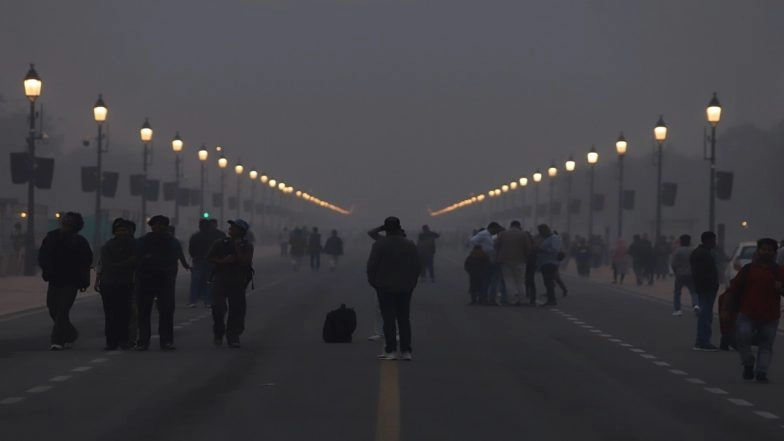
New Delhi, December 14: The national capital woke up to dense smog on Sunday morning as the average Air Quality Index (AQI) stood at 461 at 7 am, falling in the 'severe' category despite the Graded Response Action Plan (GRAP)-IV in effect across Delhi and the National Capital Region (NCR), according to the Central Pollution Control Board (CPCB). A thick haze was reported in areas including Ghazipur, the ITO area, and Anand Vihar, where visibility remained severely low. According to the CPCB, several localities across the city continued to register "severe" air quality.
Bawana recorded the highest AQI of 497 at 7 am, placing it in the 'severe' category. Narela is recording an AQI of 492, and Okhla Phase 2 is recording an AQI of 474. In contrast, NSIT Dwarka recorded the lowest AQI of 411, according to the data by the Central Pollution Control Board (CPCB). A layer of toxic smog lingers over Anand Vihar, with the Central Pollution Control Board reporting an air quality index of 491, classified as 'severe'. Other locations, such as Ashok Vihar (493), ITO (483), DTU (495), and Nehru Nagar (479), showed a severe decline in air quality, resulting in a 'severe' category. Delhi Air Pollution: Government Directs All Schools To Conduct Classes up to IX, XI in Hybrid Mode.
According to the CPCB, Najafgarh recorded an AQI of 408, while Shadipur registered 411, indicating slightly better air quality than other areas but still in the 'severe' category. Meanwhile, on Saturday, the Delhi Government's Directorate of Education directed all schools to conduct classes up to IX and XI in hybrid mode after the Commission for Air Quality Management (CAQM) invoked Stage IV of the Graded Response Action Plan (GRAP) as the Air Quality Index (AQI) neared the 'severe' mark. According to CPCB, the AQI, which ranges from 0 to 500, is divided into six categories, each reflecting the level of pollution and associated health risks.
As per the AQI categorisation, readings between 0-50 are classified as 'good', 51-100 'satisfactory', 101-200 'moderate', 201-300 'poor', 301-400 'very poor', and 401-500 'severe'. An AQI reading classified as "Good" indicates minimal or no health impact. With "Satisfactory" category, air quality remains acceptable, although sensitive groups such as children, the elderly, and individuals with respiratory conditions may experience slight discomfort. The "Moderate" category, ranging from 101 to 200, indicates increasing pollution levels that may trigger respiratory difficulties among individuals with asthma, other lung conditions, or heart disease. Delhi Air Pollution: National Capital Slips Into ‘Severe’ Air Category, Stage-III GRAP Curbs Enforced Across NCR.
Visuals From Near AIIMS as a Thick Layer of Toxic Smog Blankets the City
#WATCH | Delhi: Visuals from near AIIMS as a thick layer of toxic smog blankets the city. CAQM (Commission for Air Quality Management) has invoked all actions under GRAP Stage-IV in Delhi-NCR.
AQI (Air Quality Index) around the area is 484, categorised as 'Severe', as… pic.twitter.com/u1A7iKPb7m
— ANI (@ANI) December 14, 2025
Drone Visuals Around Ghazipur as a Layer of Toxic Smog Blankets the City
#WATCH | Delhi | Drone visuals around Ghazipur area this morning as a layer of toxic smog blankets the city; GRAP 4 invoked in the national capital.
AQI (Air Quality Index) around the area is 491, categorised as 'Severe', as claimed by CPCB (Central Pollution Control Board). pic.twitter.com/RRGgUwGleD
— ANI (@ANI) December 14, 2025
Anti-Smog Gun Being Used to Sprinkle Water on the Roads in Delhi
VIDEO | Anti-Smog gun being used to sprinkle water on the roads in Delhi to reduce dust and air pollution. Visuals from India Gate area.
With air quality worsening across the Delhi-NCR region, GRAP-4 has been invoked to curb pollution.#DelhiSmog #AirPollution #GRAP4
(Full… pic.twitter.com/Rt70hn89qs
— Press Trust of India (@PTI_News) December 14, 2025
Prolonged exposure to "Poor" air can cause breathing discomfort to most people, not just those with pre-existing health issues. This level has become increasingly common in several parts of the capital during winter. Levels between 301 and 400 are classified as "Very Poor" and pose a risk of respiratory illness, even among healthy individuals, when exposure persists for extended periods. The most hazardous category, "Severe," includes AQI values from 401 to 500. At this stage, air quality becomes dangerous for everyone.