Delhi-NCR Air Pollution: Heavy Smog Engulfs City As Air Quality Slips to ‘Very Poor’ Category (Watch Video)
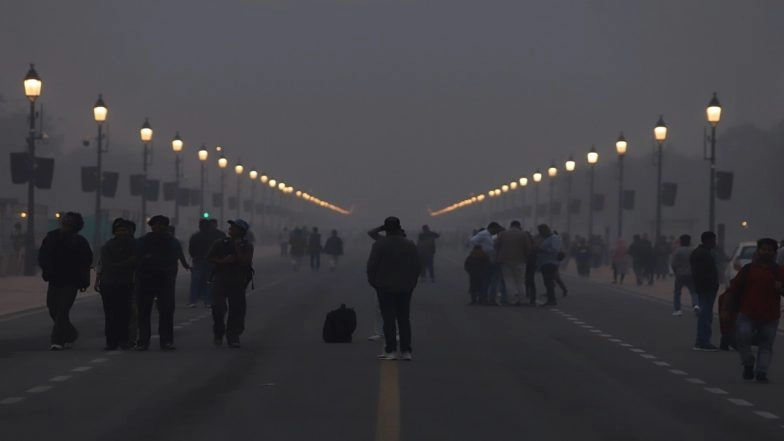
A thick blanket of smog enveloped the National Capital Region (NCR) on Saturday, pushing air quality to alarming levels and raising serious public health concerns. The overall AQI for Delhi stood at 387, firmly within the “very poor” category, signalling significant health risks, particularly for children, the elderly and those with respiratory ailments.

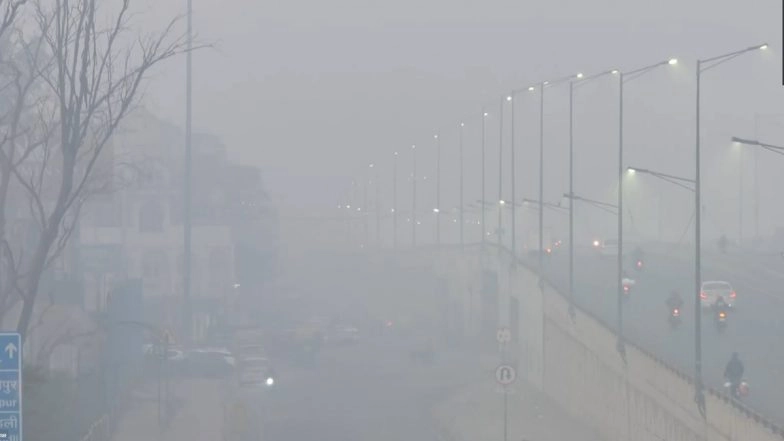
New Delhi, December 13: A thick blanket of smog enveloped the National Capital Region (NCR) on Saturday, pushing air quality to alarming levels and raising serious public health concerns. The overall Air Quality Index (AQI) for Delhi stood at 387, firmly within the “very poor” category, signalling significant health risks, particularly for children, the elderly and those with respiratory ailments. The deterioration in air quality has been steady throughout the week.
On Tuesday, the city recorded an AQI of 282, categorised as “poor,” followed by 259 on Wednesday. Pollution levels worsened sharply thereafter, rising to 307 on Thursday and surging to 349 on Friday before edging close to the “severe” mark. Environmental experts have attributed the worsening conditions to a combination of stagnant winds, vehicular emissions, industrial activity and seasonal factors, including crop residue burning in neighbouring states. Large parts of the National Capital Territory are now grappling with hazardous air quality. Rahul Gandhi Calls for Debate, Formulation of National Plan To Combat Air Pollution (Watch Video).
According to official data, as many as 18 localities recorded an AQI above 400, placing them in the “severe” category. Wazirpur emerged as the worst-hit area with an AQI of 443, followed closely by Jahangirpuri at 439 and Vivek Vihar at 437. Other severely polluted areas include Rohini and Anand Vihar (434 each), Ashok Vihar (431), Sonia Vihar and Delhi Technological University (427 each), Narela (425), Bawana (424), Nehru Nagar (421), Patparganj (419), ITO (417), Punjabi Bagh (416), Mundka (415), Burari Crossing (413), Chandni Chowk (412) and DU North Campus (401).
Health experts warn that prolonged exposure to such high pollution levels can lead to aggravated asthma, reduced lung function, cardiovascular stress and eye and throat irritation. Authorities have urged residents to limit outdoor activities, wear protective masks and follow advisories issued under the Graded Response Action Plan (GRAP), which may be intensified if conditions fail to improve. Meanwhile, Delhi is currently experiencing cool and cloudy weather, with temperatures hovering around 10 degrees Celsius. The minimum temperature is expected to dip to 8 degrees Celsius later tonight. 'You Can Actually Breathe In Bangalore': Bengaluru Man Says His Nose Is Blocked and Throat Is Choked After Spending 3 Weeks in North India, Flags Air Pollution Issue (Watch Video).
Visuals From the Akshardham
#WATCH | Delhi | Visuals from the Akshardham area as a thick layer of toxic smog blankets the city.
AQI (Air Quality Index) around the area is 419, categorised as 'Severe, as claimed by CPCB (Central Pollution Control Board). pic.twitter.com/5wA1MtSqil
— ANI (@ANI) December 13, 2025
Visuals From the Anand Vihar Area
#WATCH | Delhi | Visuals from the Anand Vihar area as a thick layer of toxic smog blankets the city.
AQI (Air Quality Index) around the area is 434, categorised as 'Severe, as claimed by CPCB (Central Pollution Control Board). pic.twitter.com/jWjHxAfkyf
— ANI (@ANI) December 13, 2025
While conditions are relatively milder than what is typically experienced in mid-December, dense fog during the early morning and late evening hours has added to commuters’ woes. Meteorological officials have indicated that colder conditions are likely to set in as the month progresses, which may further impact air quality if wind speeds remain low.
(The above story first appeared on LatestLY on Dec 13, 2025 08:52 AM IST. For more news and updates on politics, world, sports, entertainment and lifestyle, log on to our website latestly.com).