Upcoming Layoffs in 2026: The New List of Safe vs Unsafe Jobs
2026 Layoffs Forecast and Roles That Are Safe vs Jobs Most Unsafe: An in-depth 2026 Layoffs prediction analyzing why US job cuts are different this year. Know from the Atlassian layoffs to the J.P. Morgan unemployment data, how to stay safe in an automated market. Explore high-risk Jobs like Customer Support and identify the safe role for traditional professionals.

The narrative of the American workforce is being rewritten in real-time. We have moved past the "over-hiring" corrections that defined the previous two years and entered a period of deliberate, surgical transformation. High-profile restructuring at Oracle, which is currently shifting thousands of roles to prioritize its massive $300 billion OpenAI infrastructure project, and Atlassian’s recent decision to cut 10% of its workforce (1,600 roles) to "self-fund" its AI pivot, are the new industry benchmarks. Even established giants like Amazon and Meta are leaning into this strategy. Amazon alone has eliminated 16,000 corporate positions this year, citing a culture-led reorganization toward leaner, automated teams.
This isn't just a standard downturn; it's a fundamental recalibration of what "expertise" means. We are seeing a historic pivot where companies are trading traditional human capital for AI-driven productivity. The workforce isn't shrinking solely for the sake of the bottom line; it is being reshaped because the shelf-life of legacy skills has plummeted, creating a "Skill Crisis" where years of experience are being outpaced by the need for AI orchestration. Also Read: Why US Layoffs in 2026 are Different: AI Pivot or Skill Crisis?
2026 Layoff Predictions for Tech and Finance
Research from J.P. Morgan, Challenger, Gray & Christmas, and Gartner suggests that the layoff trend will remain surgical rather than systemic through the end of the year:
The "Bifurcated" Recovery: Economists at J.P. Morgan describe the current climate as a "low-hire, low-fire" environment for the general economy. While most sectors remain stable, Tech layoffs have surged 51% in early 2026 as firms aggressively liquidate traditional roles to fund AI infrastructure.
Unemployment Projections: J.P. Morgan analysts expect the US unemployment rate to peak at 4.5% by mid-2026 before potentially stabilizing as the market absorbs the first major wave of AI-displaced workers.
The 20% Rule: Currently, one in five layoffs is explicitly linked to AI integration. Furthermore, 66% of hiring managers now state they will prioritize candidates with "AI-augmentation" skills over those with years of legacy experience.
The Middle Management "Flattening": Predictions suggest that by December 2026, 20% of organizations will have eliminated at least one layer of middle management to increase organizational "agility" and reduce overhead.
2026 Layoffs Forecast: Jobs That Are Safe and Unsafe
This "Great Reshuffle" is driven by a growing Skill Crisis. The layoffs are not merely cost-cutting measures; they represent a fundamental Darwinian shift where legacy roles are being phased out in favor of AI-native operations.
Customer Support Specialists are currently facing the highest level of exposure. With the maturation of "Agentic AI," companies are now able to automate nearly 70% of routine service tasks. Salesforce, for example, recently reduced its headcount by 4,000, citing that AI agents now handle half of all basic customer interactions.
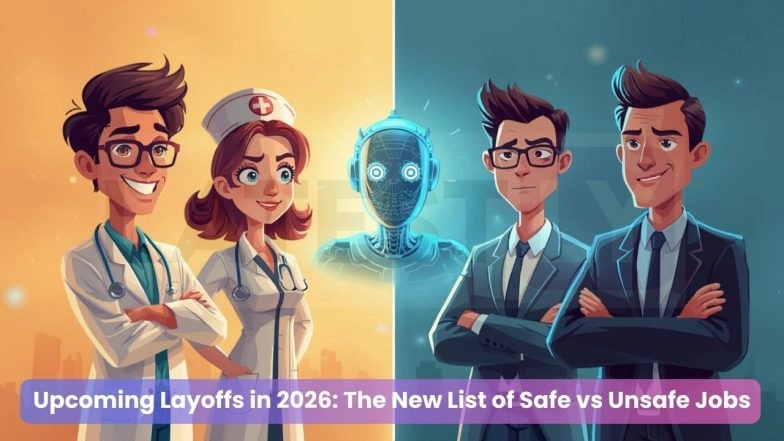
2026 Layoffs Analysis: Roles That Are Safe vs. Jobs Most Unsafe
| Role/Job Category | Risk Level | Why it is Unsafe (Primary Driver) | The 2026 "Safe Zone" Context |
| Customer Support | Critical | Unsafe: AI Agents handle 70% of Tier-1 tasks. | Safe: Escalation Managers & AI Trainers. |
| Middle Management | High | Unsafe: AI-driven reporting flattens hierarchies. | Safe: Strategic Directors & Change Leads. |
| Data Operations | High | Unsafe: Automated mapping renders manual entry obsolete. | Safe: Data Privacy & Governance Officers. |
| Software QA | High | Unsafe: AI handles 80% of regression testing. | Safe: AI System Architects & Cybersecurity. |
| Skilled Trades | Low | Safe: AI cannot navigate complex physical sites. | Safe: Electricians, Plumbers, HVAC Techs. |
| Healthcare | Low | Safe: High empathy & physical care requirements. | Safe: Nurses, Surgeons, Therapists. |
The "Safe Zones" of 2026: Jobs Where Stability Remains
Despite the turbulence, several sectors are proving to be "AI-resilient," relying on human empathy, physical dexterity, or ethical oversight.
- High-Touch Healthcare: Roles in nursing, surgery, and mental health remain the safest. While AI aids in diagnostics, it cannot replicate the human connection essential for patient care.
- The Skilled Trades: Plumbers, electricians, and HVAC technicians are currently immune to automation. The robotics required to navigate complex, non-standard physical environments remain years away from mass viability.
- AI Governance and Ethics: A new category of "Safe Roles" has emerged. Organizations are aggressively hiring AI Ethics Officers and Governance Managers to mitigate the legal and reputational risks of their own automation.
- Complex Relationship Management: High-stakes B2B sales and strategy roles remain secure. Large-scale negotiations still require the trust and cultural nuance that only a human can provide.
In 2026, job security is no longer guaranteed by tenure; it is defined by adaptability. The "Skill Crisis" is a signal to the workforce that the shelf-life of traditional expertise is shrinking. To remain safe in this transitioning market, professionals must evolve from being "task-performers" into "AI-Orchestrators." The most successful workers of 2026 will not be those who compete with technology, but those who prove they are indispensable in governing it.
(The above story first appeared on LatestLY on Mar 12, 2026 10:42 PM IST. For more news and updates on politics, world, sports, entertainment and lifestyle, log on to our website latestly.com).