













 Quickly
 Socially
 Trending
 Crypto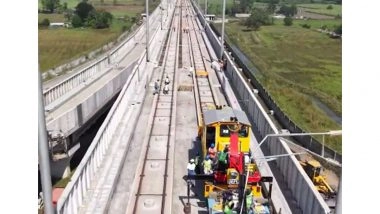
New Delhi [India], January 20 (ANI): Work on the Mumbai-Ahmedabad Bullet Train Project has reached a key construction milestone with rapid progress in the installation of overhead electrification (OHE) masts, reinforcing the government's push to build world-class infrastructure under the 'Make in India' initiative.
Union Railways, Communications, Electronics and IT Minister Ashwini Vaishnaw in a post on social media on Monday said work on installing OHE masts along the corridor is advancing at a good pace, marking a critical step toward enabling electric traction for India's first bullet train service.
Also Read | Basant Panchami 2026: Date, Saraswati Puja Muhurat, Tithi Timings and Rituals.
The OHE masts form the backbone of the traction system that will power high-speed trains on the corridor. Installation is currently underway across several stretches, including elevated viaduct sections, where precision engineering is required to ensure safety, stability and uninterrupted operations at very high speeds.
According to officials, more than 20,000 steel OHE masts will be installed across the alignment. These masts, ranging in height from about 9.5 metres to 14.5 metres, will support the complete 2x25 kV overhead traction system, including contact and catenary wires, fittings, earthing arrangements and other associated equipment essential for bullet train operations.
Also Read | Gurugram Road Rage: Doctor Rams SUV Into Swiggy Delivery Agent Multiple Times Over Minor Dispute, Arrested.
Many of the masts are being erected on viaducts constructed at significant heights above ground, underscoring the technical complexity of the project. The electrification infrastructure is being designed to meet global high-speed rail standards while being manufactured largely within India, boosting domestic capabilities.
To ensure a reliable and continuous power supply, a chain of Traction Substations (TSS) and Distribution Substations (DSS) is also being developed along the 508-km Mumbai-Ahmedabad corridor. These facilities will feed and regulate power for the high-speed trains.
Once operational, the bullet train is expected to dramatically reduce travel time between Mumbai and Ahmedabad, enhance regional connectivity and stimulate economic activity along the route. The project is also projected to generate employment, strengthen Indian manufacturing and mark a major step in the adoption of advanced rail technology in the country. (ANI)
(The above story is verified and authored by ANI staff, ANI is South Asia's leading multimedia news agency with over 100 bureaus in India, South Asia and across the globe. ANI brings the latest news on Politics and Current Affairs in India & around the World, Sports, Health, Fitness, Entertainment, & News. The views appearing in the above post do not reflect the opinions of LatestLY)
 Share Now
 Google Trends



 Live Bot