













 Quickly
 Socially
 Trending
 Crypto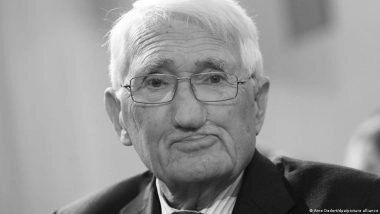
One of Germany's greatest postwar intellectuals, he continuously argued for a robust and inclusive democracy. His passing marks the end of an era.Jürgen Habermas, world-renowned German philosopher and sociologist, has died in the town of Starnberg near Munich, where he has lived since 1971, the Suhrkamp publishing house said.
One of the most influential thinkers of the 20th century, he remained active until his final years, and was one of the few public intellectuals in Germany to regularly take a stand on political issues.
Having advocated for the right to asylum during the 2015 migrant crisis, and for a unified European Union in the face of right-wing populism and nationalism, Habermas remained actively committed to his cosmopolitan ideal of an open and rigorous democracy.
He was awarded the German French Media Prize in 2018, and after turning 90 the following year, published a two-volume, 1,700-page work, This Too a History of Philosophy, a look at the evolution of human rationality and reason that the Boston Review called "a masterpiece of erudition and synthesis."
Having received major international prizes throughout his career, including the 2007 Holberg International Memorial Prize, worth about €520,000, in 2021 he accepted and then rejected a €225,000 award from the United Arab Emirates (UAE). With the Gulf absolutist monarchy accused of repression, he decided it was "wrong" to accept the award as it was seen to contradict his principles of freedom of opinion and open democratic debate.
The evolution of the public sphere
Jürgen Habermas was born in Düsseldorf in 1929. As a young man, he was interested in social issues and after studying philosophy, economics and German literature, he first worked as a freelance journalist.
He earned a doctorate in philosophy in Bonn in 1954. His postdoctoral thesis from 1961, Strukturwandel der Öffentlichkeit (published in English translation in 1989 as The Structural Transformation of the Public Sphere), remains a groundbreaking work that explores the evolution and importance of the public opinion and the "public sphere" in democratic societies.
Habermas' work aroused the interest of Theodor W. Adorno, who, along with Max Horkheimer and Herbert Marcuse, founded a brand of social and critical theory under the so-called Frankfurt School first established in the Weimar years. Working at Frankfurt's Institute for Social Research, this intellectual circle explored the question of how enlightened thinking, which brought people liberation from the forces of nature and superstition through their own reason, could have drifted into the barbarism of National Socialism.
In 1964, Habermas took over the chair of philosophy and sociology at the University of Frankfurt from Max Horkheimer, where he continued the Frankfurt School project of social and political development beyond the rigid confines of both capitalism and Marxism-Leninism.
Fighting fascism with democracy
Like other postwar West German authors and intellectuals, including Martin Walser, Günter Grass and Siegfried Lenz, Habermas grew up in the shadow of Nazism. This experience left its mark on his life's work, which ultimately asked how a repetition of the Holocaust could be prevented. His mission was to nurture communication models based on "consensus," through which members of a society could aim to balance their different interests.
His ideas would inform the Federal Republic of Germany's self-image. Citizens were no longer to receive orders from above; rather, they should be encouraged to intervene in the public sphere, to formulate their views openly and include them into a large-scale discussion that would work towards an acceptable compromise.
His theories promoting a robust and open democracy are said to have influenced the 1968 student protests. But while Habermas became a spiritual mentor to the students, he disavowed the radical elements of the movement that advocated terrorism in the vein of the Red Army Faction.
Habermas further elaborated on his concept of the public sphere after he relocated to Starnberg near Munich to become co-director of the new Max Planck Institute in 1971. There he published his two-volume magnum opus, the Theory of Communicative Action (1981), in which he proposed that language and communication must be the foundation of a society in which open debate and reasoned public opinion drives social progress.
He later applied these ideas to the European Union, which he hoped would be a democratic bulwark against nationalism. Addressing the "Which future for Europe?" forum in Berlin in 2017, he said he feared that the European project had to embolden the public sphere, and not remain the domain of elites. "European unification has remained an elite project because political elites have avoided involving the wider public in an informed debate about alternative scenarios for the future," he said.
Habermas as philosopher-king
It was not until 1983 that Jürgen Habermas returned to Frankfurt, where he taught philosophy until his retirement in 1994. But the thinker continued to exert influence on social and political debate.
In 1999, for example, he supported the controversial NATO efforts to end the war in Kosovo by bombing Serbia: "If there is no other way, democratic neighbors must be able to rapidly intervene with emergency aid legitimized under international law," he said.
As a proponent of European integration, Habermas repeatedly pointed to democratic deficits in the EU. In the context of the euro crisis in he early 2010s, he warned against too rigid austerity and promoted the expansion of the monetary union into a "supernational" democracy in which nation-states surrender further sovereignty.
Habermas was born with a cleft lip and was teased by other children at an early age. Perhaps, as his biographer Stefan Müller-Doohm suspects, this is why he was concerned with the subject of communication throughout his life.
Working into his 90s, the secondary literature on Habermas' work alone comprises more than 14,000 books and articles, including many doctoral theses. The philosopher was listed as the seventh most-cited author in the humanities and social sciences by The Times Higher Education Guide.
An asteroid discovered in 1999 on the edge of the solar system is named after the great thinker. Even in death, his star will continue to shine brightly.
Edited by: Elizabeth Grenier
(The above story first appeared on LatestLY on Mar 14, 2026 08:30 PM IST. For more news and updates on politics, world, sports, entertainment and lifestyle, log on to our website latestly.com).
 Share Now
 Google Trends



 Live Bot