
India News | Amit Shah, Gujarat CM Patel Inaugurates Earth Summit 2025-26 in Gandhinagar
Get latest articles and stories on India at LatestLY. The Union Home and Cooperation Minister Amit Shah and Chief Minister Bhupendra Patel on Friday inaugurated the two-day "Earth Summit 2025-26" at Mahatma Mandir, Gandhinagar, as per an official release by the Chief Minister's office.

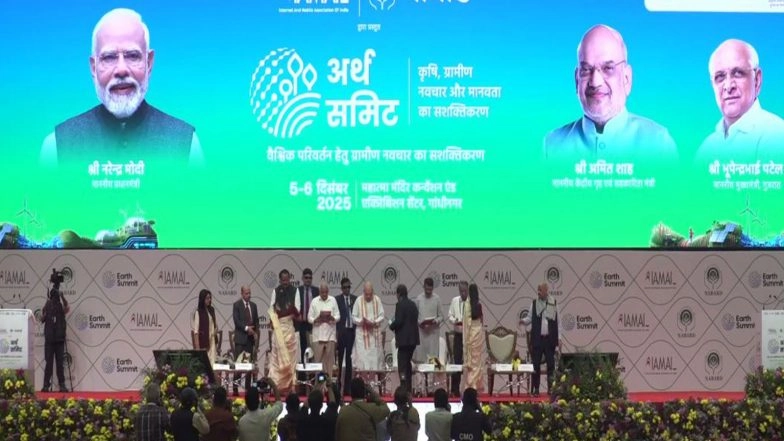
Gandhinagar (Gujarat) [India], December 5 (ANI): The Union Home and Cooperation Minister Amit Shah and Chief Minister Bhupendra Patel on Friday inaugurated the two-day "Earth Summit 2025-26" at Mahatma Mandir, Gandhinagar, as per an official release by the Chief Minister's office.
The summit is jointly organised by the National Bank for Agriculture and Rural Development (NABARD) and the Internet and Mobile Association of India (IAMAI). On this occasion, the Union Cooperation Minister and the Chief Minister also visited various stalls at the event.
Gujarat Legislative Assembly Speaker Shankar Chaudhary, State Agriculture and Cooperation Minister Jitu Vaghani, and Deputy Speaker of the Assembly Jethabhai Ahir graced the event.
On this occasion, Union Home Minister Amit Shah stated that a series of three "Earth Summits" has been organised to position the rural economy as the largest contributor to the nation's GDP.
The second edition of this series is being held in Gujarat, the land of Mahatma Gandhi. Mahatma Gandhi had emphasised even before independence that India's development could never be envisioned without focusing on its rural areas. Unfortunately, for many years after independence, three vital pillars of rural development, agriculture, animal husbandry, and the cooperative sector, were largely overlooked.
Since assuming office as Prime Minister in 2014, Narendra Modi has initiated a new wave of transformation in the country by prioritising the development of these three sectors, thereby reviving Mahatma Gandhi's vision, the release said.
"To make the Ministries of Rural Development, Agriculture, and Cooperation stronger and more results-oriented, impacting the future of 80% of the nation's population, the Prime Minister has tripled their combined budget since 2014. While the combined budget of these ministries was Rs. 1.02 lakh crore in 2014, it has risen to over Rs. 3.15 lakh crore in 2025-26, added Amit Shah.
He said that as the country marks 100 years of independence, the shared aspiration of all citizens is for India to lead globally in every sector. The vision of a complete Viksit Bharat can be achieved only through the welfare of every citizen.
To enhance citizens' welfare and strengthen the cooperative sector, the Government of India plans to establish one cooperative institution in every panchayat and create over 50 crore active cooperative members nationwide, aiming to triple the cooperative sector's contribution to the nation's GDP.
Referring to the Earth Summit theme, "Empowering Rural Innovation for Global Change," Amit Shah stated that the summit's primary goal is to deliberate, reflect, and hold result-oriented discussions on how small innovations and initiatives in the rural sector can boost its contribution to the national economy and improve services for citizens.
He expressed confidence that the insightful discussions at the summit will provide solutions to many major challenges facing India's rural economy.
They stated that the third edition of the Earth Summit will be organised in Delhi next year. After the completion of all three editions, a strong foundation will be established for the development of India's rural economy. At the same time, the cooperative sector will become more transparent, inclusive, and profitable.
The Union Minister further noted that to date the Earth Summit has brought together over 10,000 delegates, more than 1,200 corporates, over 500 expert speakers, more than 300 start-ups, over 250 exhibitors, and more than 50 investors, along with the conduct of over 30 workshops and masterclasses.
Union Minister Shah emphasised that the cooperative sector cannot advance without technology; however, developing software and managing data storage costs is not feasible for small cooperative societies.
To overcome this challenge, NABARD has introduced over 13 digital services as portals under the 'Sahakar Sarathi' initiative, including Sahakar Sarathi, Sahakar Setu, Sangrah Sarathi, and others.
This initiative will unite rural, district, and urban cooperative banks on a single platform, equipping them with modern technology on par with that of private banks. The technology will support functions such as collections, legal documentation, and KYC.
Shah was confident that the 'Sahakar Sarathi app, developed under the Cooperative Banking Act, will be instrumental in ensuring compliance with all RBI regulations and, in the near future, will offer e-KCC and Kisan Credit Card holders facilities akin to high-limit credit cards.
The Union Minister highlighted that a successful "Cooperation Among Cooperatives" experiment was conducted in Banaskantha and Panchmahal, Gujarat.
Under this initiative, each cooperative institution's bank account and its savings were operated directly within the cooperative bank.
The experiment produced remarkable results, generating low-cost deposits worth thousands of crores in cooperative banks. Drawing on the policy insights from this successful model, necessary improvements will be made before rolling it out across the country.
The Minister noted that the adoption of natural farming, vital for global health, is steadily rising in India. Currently, 49 lakh farmers have embraced natural farming. To ensure the credibility of their products, the Government of India, in partnership with India Organics and Amul Organics, is establishing a comprehensive laboratory chain.
This will enable every farmer to have their products tested to international organic standards and export them across India and globally. Recently, Amul Organics made 40 food products available online.
India's share in the global organic food market is projected to surpass 20% by 2030 and exceed 40% by 2035.
Furthermore, the Union Minister highlighted the development of the cooperative sector, citing the cooperative taxi initiative, stating that, within the next two years, the cooperative taxi service is expected to become the country's largest taxi company.
In the recently launched trial in Delhi, 51,000 drivers have already registered. Similarly, the cooperative sector is set to introduce cooperative insurance in the near future, which will employ youths in every village.
Speaking on the occasion, Gujarat Chief Minister Bhupendra Patel described organising the second edition of the Earth Summit at Mahatma Mandir, Gandhinagar, as timely.
He stated that this two-day summit, aimed at empowering agriculture, rural sectors, humanity, and innovation, aligns perfectly with the ideas of strengthening the rural economy.
The Chief Minister added that the two-day summit will serve as a robust platform, bringing together cooperative organisations, banks, policymakers, startups, innovators, agri-scientists, researchers, and scholars, thereby facilitating the realisation of Prime Minister Shri Narendra Modi's vision of a Viksit Bharat.
Chief Minister Bhupendra Patel emphasised the pivotal role Gujarat has played, under the leadership of the country's first Cooperative Minister, Amit Shah, in accelerating the rural economy.
He detailed the state's initiatives in financial inclusion, circular economy, green growth and climate resilience, agriculture, natural farming, animal husbandry, women's participation, rural employment, and overall rural development, highlighting the path of cooperative-driven prosperity that Gujarat has charted.
At the event, Union Cooperation Minister Amit Shah inaugurated the 'Sahakar Sarathi' initiative and its suite of digital services. He also released the State Government's "State Focus Paper of Gujarat 2026-27" and the NABARD-BCG research paper titled "The Future of Rural Banking."
At the beginning of the event, NABARD Chairman Shri Shaji K.V. extended a warm welcome to all attendees and presented a comprehensive overview of the Earth Summit's objectives and the various sessions scheduled over the two days.
The event was attended by Chairman of Gujarat State Cooperative Bank Ajay Patel, Secretary of the Union Ministry of Cooperation Dr Ashish Kumar Bhutani, Additional Chief Secretary of the State Agriculture Department Dr Anju Sharma, along with senior officials from the state and central governments, bankers, entrepreneurs, and a large number of leaders associated with the cooperative sector, including farmers. (ANI)
(The above story is verified and authored by ANI staff, ANI is South Asia's leading multimedia news agency with over 100 bureaus in India, South Asia and across the globe. ANI brings the latest news on Politics and Current Affairs in India & around the World, Sports, Health, Fitness, Entertainment, & News. The views appearing in the above post do not reflect the opinions of LatestLY)