













 Quickly
 Socially
 Trending
 Crypto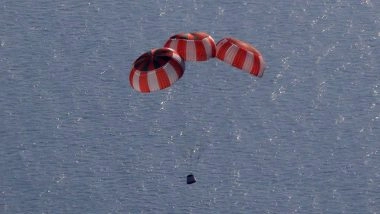
New Delhi [India], April 10 (ANI): Union Minister Jitendra Singh on Friday congratulated the Indian Space Organisation for successfully conducting the second Integrated Air Drop Test (IADT-02) for the ambitious Gaganyaan mission, marking a key step towards India's first human spaceflight scheduled next year.
In a post on X, Singh said, "Congratulations #ISRO for the successful accomplishment of Second Integrated Air Drop Test (IADT-02) for #Gaganyaan, India's first Human Space flight scheduled next year. The second Integrated Air Drop Test (IADT-02) was successfully conducted at Satish Dhawan Space Station, Sriharikota. This marks an important milestone towards the readiness for the Gaganyaan mission."
Also Read | Pune Shocker: Woman Paralysed After Water Slide Accident at Jai Malhar Agri-Tourism Centre, FIR Registered.
https://x.com/DrJitendraSingh/status/2042427178005180631
The IADT-02 follows the successful completion of the first such test (IADT-01) conducted on August 24, 2025, at the Satish Dhawan Space Centre. The earlier test demonstrated the end-to-end performance of the parachute-based deceleration system designed for the Crew Module of the Gaganyaan mission.
Also Read | Gold Rate Today, April 10, 2026: Check 22K and 24K Gold Prices in Delhi, Mumbai, Chennai and Other Cities.
According to ISRO, the Gaganyaan mission is the country's first human spaceflight programme, aimed at demonstrating indigenous capability to send a three-member crew into a 400-km orbit for a three-day mission and return them safely to Earth. The mission will utilise the human-rated LVM3 launch vehicle.
The parachute-based deceleration system plays a crucial role during the final phase of descent, ensuring the Crew Module lands safely in the sea by reducing its velocity to acceptable limits. The system comprises multiple parachutes, including Apex Cover Separation parachutes, Drogue parachutes, Pilot parachutes, and Main parachutes, all deployed in a precise sequence.
During IADT-01, a simulated Crew Module weighing approximately 4.8 tonnes was dropped from an altitude of around 3 kilometres using the Indian Air Force's Chinook helicopter. The test successfully validated the deployment sequence and performance of the parachutes, ultimately reducing the module's touchdown velocity to about 8 metres per second.
The test also simulated an abort scenario on the launch pad, with onboard avionics triggering the deployment sequence and recording key parameters for analysis. Following splashdown, the module was recovered by naval teams.
The Gaganyaan programme has seen collaboration from multiple agencies, including DRDO, the Indian Air Force, Indian Navy, and Coast Guard, with more such tests planned to further validate system performance under varying conditions. (ANI)
(The above story is verified and authored by ANI staff, ANI is South Asia's leading multimedia news agency with over 100 bureaus in India, South Asia and across the globe. ANI brings the latest news on Politics and Current Affairs in India & around the World, Sports, Health, Fitness, Entertainment, & News. The views appearing in the above post do not reflect the opinions of LatestLY)
 Share Now
 Google Trends



 Live Bot