
India News | PM Modi Silent on Impact of US Trade Deal on Farmers: DMK MP Kanimozhi
Get latest articles and stories on India at LatestLY. The United States and India announced a framework for an Interim Agreement on reciprocal, mutually beneficial trade, reaffirming their commitment to a broader Bilateral Trade Agreement (BTA) launched by President Donald Trump and Prime Minister Narendra Modi on February 13, 2025.

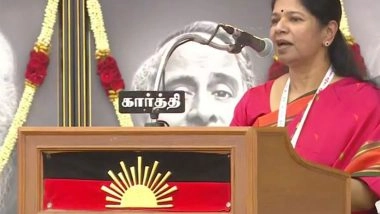
Virudhunagar (Tamil Nadu) [India], February 7 (ANI): DMK MP Kanimozhi on Saturday criticised the India-US interim trade agreement, saying the deal would disproportionately benefit the United States while putting Indian farmers at a disadvantage.
Addressing the DMK Youth Wing Southern Zone Office-Bearers Conference in Virudhunagar, DMK MP said India's trade deal with the US taxes Indian exports at 18% while US imports face no tax, questioning its impact on farmers and noting that PM Modi has not responded to the same.
"They say that India has entered into a trade agreement with the United States and that it will bring a major change. Goods exported from India will be taxed at 18%. Goods imported from there will be tax-free. We cannot compete with them--what will happen to our farmers' conditions? Modi has not given any answer to this," Kanimozhi said.
The United States and India announced a framework for an Interim Agreement on reciprocal, mutually beneficial trade, reaffirming their commitment to a broader Bilateral Trade Agreement (BTA) launched by President Donald Trump and Prime Minister Narendra Modi on February 13, 2025.
Also Read | Noida Flower Show 2026: Dates, Venue, Timings and All You Need to Know About the Colourful Festival.
As part of the framework, India has agreed to eliminate or reduce tariffs on all US industrial goods and a wide range of US agricultural and food products, including dried distillers' grains (DDGs), red sorghum for animal feed, tree nuts, fresh and processed fruit, soybean oil, wine and spirits, and additional products.
On the other hand, the United States will impose a reciprocal tariff of 18 per cent on goods originating in India, including textiles and apparel, leather and footwear, plastic and rubber products, organic chemicals, home decor, artisanal goods and certain machinery. Subject to the successful conclusion of the Interim Agreement, the US has said it will later remove reciprocal tariffs on select items, including generic pharmaceuticals, gems and diamonds, and aircraft parts.
Notably India-US Interim Agreement states that India will eliminate or reduce tariffs on all U.S. industrial goods and a wide range of US food and agricultural products, including dried distillers' grains (DDGs), red sorghum for animal feed, tree nuts, fresh and processed fruit, soybean oil, wine and spirits, and additional products.
Tariffs on almonds, walnuts, pistachios, and apples are reduced. While this increases competition for high-value horticultural farmers in regions such as Kashmir and Himachal Pradesh, many of these items were already being imported in large volumes to meet high domestic demand.
The agreement creates a "two-way street" for the fruit industry, balancing new export opportunities with strict domestic protections: New Export Opportunities: Indian fruit growers gained zero-duty access to the $30 trillion US market for several high-value products. These include tropical fruits: mangoes, bananas, guavas, pineapples, papayas, and avocados.
To safeguard domestic livelihoods, the Indian government excluded several "sensitive" fruits and vegetables from tariff concessions. Concessions were specifically denied for strawberries, cherries, citrus fruits, and pulses, including green peas and kabuli chana.
While India granted some quota-based concessions for US apples, it maintained a Minimum Import Price (MIP) of ₹80 per kg and a 25% import duty. This ensures that US apples priced below ₹100 per kg cannot enter the Indian market, protecting local Himalayan orchards from being undercut by cheaper imports.
Moreover, while addressing a press conference on the India-US Joint Statement, Minister Goyal said, "Agricultural products from Indian farmers will be exported to the United States at zero duty. At the same time, no tariff concessions have been granted to US agricultural products entering the Indian market. The agreement also makes it clear that genetically modified (GM) food will not be allowed into India."
"I can state categorically and without any hesitation that India's farmers, MSMEs, artisans, and craftsmen will not suffer any loss. On the contrary, India will benefit from greater access to the US market," the minister said.
Furthermore, DMK leader Kanimozhi accused the central government of withholding funds for schoolchildren in Tamil Nadu.
"They have withheld the funds meant for school children in Tamil Nadu. They insisted on imposing Hindi and said that Rs 3,500 crore would be released only if it was accepted, and kept the funds on hold," she said.
Kanimozhi further claimed that an anti-DMK alliance is forming ahead of the upcoming state elections, with members sharing the stage with Prime Minister Narendra Modi.
"Women and young people are with us. They know with whom Tamil Nadu will remain safe. An alliance has been formed against us. All those in this alliance are sharing the stage with Prime Minister Modi," she said.
Kanimozhi further added that Tamil Nadu received no funds in the Union Budget 2026. "A few days ago, the Budget was presented in Delhi. At the time, our Chief Minister said on X that, as elections approached, he hoped at least some funds would be allocated to Tamil Nadu. However, no funds were provided. They have entered into a treacherous alliance with the BJP," Kanimozhi added.
The Union Budget 2026, tabled on Sunday (February 1, 2026), was the ninth consecutive budget presented by Finance Minister Nirmala Sitharaman in the Parliament. (ANI)
(The above story is verified and authored by ANI staff, ANI is South Asia's leading multimedia news agency with over 100 bureaus in India, South Asia and across the globe. ANI brings the latest news on Politics and Current Affairs in India & around the World, Sports, Health, Fitness, Entertainment, & News. The views appearing in the above post do not reflect the opinions of LatestLY)