Trump’s Arch Plan and the History of Gateways
The proposed 250‑foot arch has sparked debate in Washington.

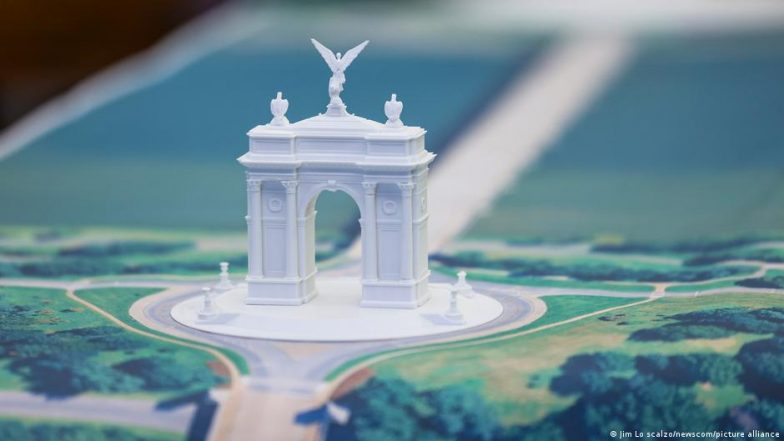
The proposed 250‑foot arch has sparked debate in Washington. But monumental gateways have shaped politics, memory, and ritual across cultures for millennia.It was an idea US President Donald Trump first floated in October last year: a triumphal arch in Washington, DC to mark the 250th anniversary of the US Declaration of Independence on July 4.
Also Read | Sports News | BCCI Ethics Officer Clears MS Dhoni of Conflict of Interest Allegations.
Speaking to donors at a White House dinner, he revealed several scale models, inspired by Paris' Arc de Triomphe — earning the project the nickname, "Arc de Trump.” When asked by a CBS news reporter who the arch was for, he reportedly pointed to himself saying "me,” adding that it would be "really beautiful.”
Also Read | Sports News | IPL 2026: Gujarat Titans Name Vijay Dahiya as Assistant Coach.
He revisited the idea early this year, favoring a 250‑foot version — a structure that would tower over other recognizable city landmarks like the Lincoln Memorial (about 100 feet tall) and the White House (about 70 feet tall). The proposed site for this project will lie between Arlington National Cemetery and the Lincoln Memorial, which has drawn plenty of critics. Trump however argued that 57 global cities have arches and "we're the only major city — Washington, D.C. — that doesn't.”
Arches, including the triumphal variety, indeed have a long history that span cultures and eras.
From engineering to empire
Archeological studies show that ancient builders in Mesopotamia — whose architectural traditions span roughly from the 10th millennium to the 6th century BCE — had constructed arches using sun-dried mudbrick and mud mortar for city gates, drains, doorways and tomb chambers. They served a practical purpose: to reinforce openings and create stronger, more stable structures.
These modest engineering solutions that originated in the Middle East laid the groundwork for later civilizations, like the Romans, who initially also used it for practical purposes — in gateways, aqueducts and vaulted structures like the Colosseum.
By the late 1st century CE, the Roman arch would take on a more commemorative, propagandist role: For instance, the Arch of Titus was erected by Roman emperor Domitian to mark victory of his late brother, Titus, in the Siege of Jerusalem (70 CE) during the First Jewish–Roman War. Its bas-reliefs among others depict Roman soldiers carrying spoils from the Second Temple in Jerusalem, including a golden seven-armed menorah. As Mary Beard, Professor of Classics at the University of Cambridge has argued in her work on Roman triumphs, such monuments were designed not necessarily to record events but rather to shape how they would be remembered.
Centuries later, Napoleon Bonaparte, the French general‑turned‑emperor, commissioned the Arc de Triomphe in 1806 after his victory at the Battle of Austerlitz. The project, however, was only completed in 1836 — long after his death in 1821. The roughly 50‑meter monument has since become a national setting for ceremonies and remembrance, besides being a top-tier Instagram photo spot.
Gateways across eras
Across different regions and periods, monumental gateways have served as political and ceremonial landmarks.
Taq i-Kisra — the soaring brick arch of the Sasanian kings — is the last visible remnant of ancient Ctesiphon, once the imperial capital of the Persian Empire. Built between the 3rd and 6th centuries CE, it rises out of the plains near today’s Salman Pak in Iraq. Held up as an astonishing example of ancient engineering, the entire vault is made of unreinforced brick — meaning the arch holds itself up without any steel, concrete or hidden support. Today, it is the second largest single‑span brick unreinforced arch ever built, surpassed only by Iran’s Gavmishan Bridge.
In Berlin, the neoclassical Brandenburg Gate was commissioned by Prussia's Frederick William II as a city entrance. Its crowning quadriga — a four‑horse chariot driven by the goddess of victory — was infamously seized by Napoleon in 1806 after Prussia's defeat and taken to Paris as a war trophy; it was returned in 1814. In the 20th century, the gate became a stage for Nazi spectacle, then — after the construction of the Berlin Wall in 1961 — a potent symbol of Cold War division. When the wall fell in 1989, the Brandenburg Gate's meaning shifted again, becoming an emblem of German reunification and European openness.
Communal identity markers
But arches don't only denote power or conquest.
Across the Chinese diaspora, "paifang" — decorative gate arches — often mark the entrance to Chinatowns around the world. Their bright colours, carved roofs and traditional features, such as dragons, lions, tiled roofs and diplomatic inscriptions stand out in streetscapes, signaling a distinct cultural quarter. They draw on older uses in China, where such gateways marked sacred sites or honored families, but abroad they have become symbols of Chinese identity. Many well‑known examples — from San Francisco and Los Angeles to Washington D.C., Liverpool, London and Sydney — are modern additions shaped by urban planning, community advocacy or multicultural initiatives.
In New Delhi, the India Gate — designed by British architect Edwin Lutyens, who drew on the tradition of Roman triumphal arches such as the Arch of Constantine — was originally built as a war memorial to soldiers of the Indian Army who died between 1914 and 1921 in World War I and the Third Anglo‑Afghan War. The names of around 13,500 Indian and British soldiers are inscribed on the memorial. Over time, the area around India Gate has become one of the city's iconic public spaces, and also where national ceremonies take place and the annual Republic Day parade passes.
Sacred thresholds to spritual spaces
And finally, arches also figure prominently in sacred spaces.
In Japan, the torii at a Shinto shrine is not an arch in the structural sense but a two‑post gateway. Most are painted in bright vermilion, a colour believed to ward off evil, and visitors often bow before passing through. Stepping beneath one marks a clear transition from the secular world into the realm of the kami, the deities of Shinto belief. It acts as a symbolic threshold, reminding people that they are stepping onto sacred ground.
In medieval Europe, Gothic masons used pointed arches, rib vaults and stained‑glass windows to draw the eye upward and fill churches with what they saw as "sacred light." These ideas came together in the 12th‑century rebuilding of the Abbey of Saint‑Denis, just north of Paris, under Abbot Suger — often regarded as the first recognisable Gothic building. As the style spread, later churches and abbeys developed it further; even in ruin, Tintern Abbey in Wales shows how Gothic architecture continued to shape light and space to evoke the sacred.
Yet arches aren't just relics of the past; they still carry meaning — and sometimes trigger dispute.
In present‑day Washington, a legal challenge was filed in February 2026 by three Vietnam War veterans and an architectural historian, who argue that the proposed Independence Arch requires congressional approval and would obstruct the long‑established sightline between Arlington House and the Lincoln Memorial. They contend that this view was intentionally preserved to symbolise national unity after the Civil War, and that it has remained unobstructed for nearly a century.
Which raises a concrete question: will the city add a new arch to a landscape already dense with monuments and carefully protected vistas — and what message would it transmit today?
Edited by: Sarah Hucal
(The above story first appeared on LatestLY on Mar 11, 2026 09:30 PM IST. For more news and updates on politics, world, sports, entertainment and lifestyle, log on to our website latestly.com).