'Blood Rain' in Iran? Viral Video Shows Eerie Scene As Rainfall Turns Hormuz Island's Red Beach Seawater Blood-Red, Here's Why It Happens
Is Iran experiencing "blood rain"? Multiple videos going viral on social media show an eerie scene as heavy rainfall turns Hormuz Island's Red Beach seawater "blood-red". While clips of "blood rain" show the seawater of Red Beach turning crimson, scroll below to know why the phenomenon occurs and whether it is natural or not.

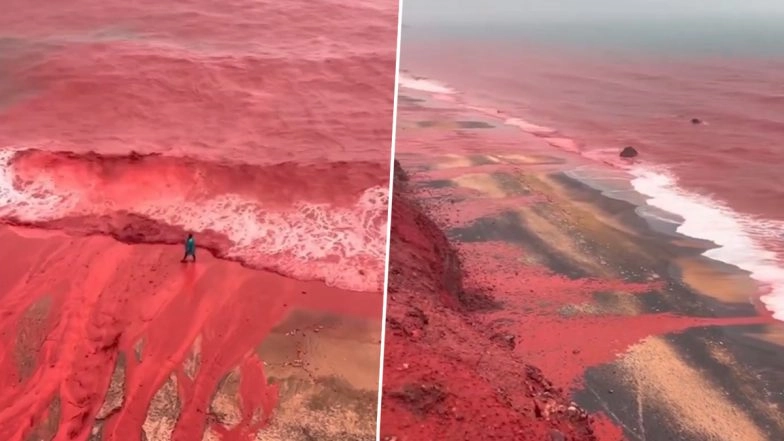
Mumbai, December 16: Is Iran witnessing "blood rain"? Multiple videos going viral on social media show the rainfall turning Red Beach's seawater on Hormuz Island in Iran "blood red". The video shows the heavy rain causing the seawater along the Red Beach on Hormuz Island to turn red, thereby creating striking scenes. "Video of the red beach during today's rain in Hormuz Island, southern #Iran," an X user said while sharing the breathtaking video showing the Red Beach turning crimson.
Did you know that Hormuz Island in Iran is also called Rainbow Island? So why does the water of the Red Sea turn crimson? It is reported that the Red Beach on Hormuz Island, which captivates visitors with its striking crimson sands and waters, is a result of high concentrations of iron oxide or hematite in the volcanic soil known locally as "gelack". The Red Beach, which is rich in minerals, is also a part of the so-called "Rainbow Island". 'Blood Rain' in Iran: Heavy Downpour Turns Red Beach on Hormuz Island Blood Red, Stunning Videos Surface.
Netizens Share Videos Showing Hormuz Island's Red Beach Turning Crimson
Today’s rain on Hormuz Island in southern Iran caused the seawater along the shore to turn red, creating striking scenes. pic.twitter.com/wU4xhZKKOa
— Weather Monitor (@WeatherMonitors) December 16, 2025
Video of the Red Beach During Today's Rain in Hormuz Island, Says X User
16-12-2025
فيديو من امطار الشاطئ الأحمر اليوم في جزيرة هرمز جنوب #ايران 📍🚨#طقس_العالم
😍🚨
Red Beach on Hormuz Island - Iran pic.twitter.com/fZeNneyK8L
— طقس_العالم ⚡️ (@Arab_Storms) December 16, 2025
Notably, the Red Beach on Hormuz Island turns crimson during heavy rainfall when the rainwater mixes red soil with seawater, thereby creating a surreal "blood rain" effect which draws tourists from across the globe. The rare and natural phenomenon also highlights Hormuz's unique geology, with the soil historically used in dyes, cosmetics, and even cuisine. Heavy rain turns the Red Beach water and sand crimson, thereby making the beach and the waves an unusual sight for visitors.
Why Does the Red Beach on Hormuz Island Turn Blood-Red?
Those walking along the shore usually come across areas where the sand glitters with metal compounds. It is worth noting that Hormuz Island's Red Beach turns strikingly crimson during rain due to the island's unique geology. The soil and surrounding cliffs are rich in iron oxide (hematite) and other minerals from layers of clay, carbonates, shale, and volcanic rocks that have oxidised over time, giving them vivid red hues. Iranian President Masoud Pezeshkian Refuses Handshake with Xi Jinping’s Wife Peng Liyuan at Beijing Parade, Video Goes Viral.
Video Shows Soil Mixing With the Water To Form Red 'Rivers' That Flows Toward the Sea
#Iran’s Red Beach is a stunning natural phenomenon caused by the island's soil containing high levels of iron oxide that turns the sand & water a bright crimson color.
Especially after rain, the soil mixes with the water to form red "rivers" that flow toward the sea. https://t.co/nvL7hBW99V
— Iran's Today (@Iran) December 16, 2025
When heavy rain falls, it erodes these iron-rich sediments, washing them down the mountainsides into the sea, where they mix with seawater to create the dramatic "blood rain" effect - often called a natural phenomenon rather than anything ominous.
(The above story first appeared on LatestLY on Dec 16, 2025 10:59 PM IST. For more news and updates on politics, world, sports, entertainment and lifestyle, log on to our website latestly.com).