Microscopic ‘Zombie Worm’ Revived: Scientists Revive Bdelloid Rotifer After 24,000 Years From Siberian Ice; Here’s What Happened Next
Scientists revived a 24,000-year-old bdelloid rotifer dubbed 'zombie worm' from Siberian permafrost. The microscopic animal survived in a state of cryptobiosis at -20 degrees Celsius since the Late Pleistocene. Once thawed, the creature resumed feeding and began reproducing as*xually, proving that complex multicellular life can survive near-total metabolic arrest for millennia.

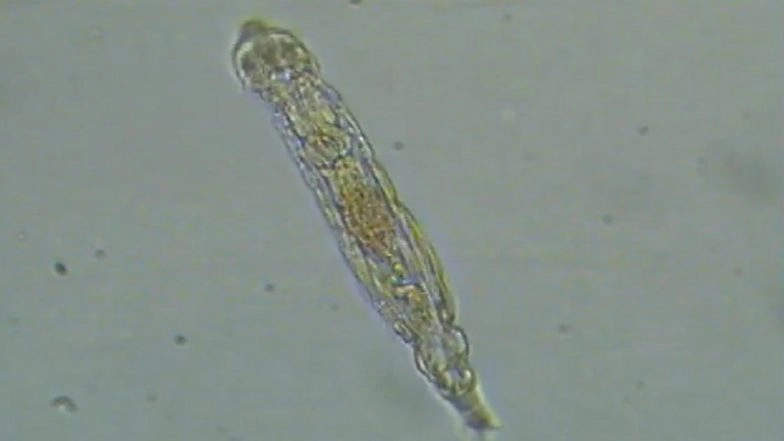
Researchers have successfully revived a microscopic multicellular animal, "zombie worm", that remained frozen in the Siberian permafrost for approximately 24,000 years. The organism, identified as a bdelloid rotifer, was recovered from the Late Pleistocene Yedoma formation near the Alazeya River. Upon being thawed, the creature not only resumed normal biological functions but also began reproducing as*xually, marking a significant milestone in the study of long-term biological preservation and extreme survival.
Rotifer's Discovery in the 'Ice Complex'
The rotifer was found within ice-rich loam approximately 24,000 years old, a period when woolly mammoths still inhabited the region. Radiocarbon dating of organic material found alongside the sample placed its age between 23,960 and 24,485 years. Real-Life Kraken: Bus-Sized Ancient Octopus Hunted Marine Giants, New Study Confirms.
According to the study published in Current Biology, the specimen remained preserved at a constant temperature of -20 degrees Celsius. Scientists noted that the sediment layers froze relatively quickly after formation and remained undisturbed by melting until the recent excavation by the Soil Cryology Laboratory.
The Mechanics of Cryptobiosis
The survival of the rotifer is attributed to a state known as cryptobiosis, where an organism’s metabolism drops to near-zero levels. This allows it to endure conditions that would typically be fatal, such as total dehydration, lack of oxygen, and extreme sub-zero temperatures. "Our report is the hardest proof as of today that multicellular animals could withstand tens of thousands of years in cryptobiosis, the state of almost completely arrested metabolism," stated study author Stas Malavin. While it was previously known that these "wheel animals" could survive a decade of freezing, this discovery proves their cellular structures can remain viable for millennia.
Revival and Reproduction by 'Zombie Worm'
Once researchers gently thawed the sample in a laboratory setting, the rotifer resumed feeding and moving. Most significantly, it began reproducing via parthenogenesis - a form of asexual reproduction typical of its species. Because bdelloid rotifers do not require a mate, the revived organism successfully created a colony of genetic clones, allowing scientists to study its ancient lineage in real-time. Despite popular descriptions of the creature as a "zombie worm", biologists clarify that the rotifer was never technically dead. Instead, it was in a state of suspended animation, successfully preserving its muscles, nerves, and gut throughout its time in the ice. New Images Show Clitoris Anatomy in 3D.
Implications for Complex Life
The ability of a complex, microscopic animal to survive such a lengthy "shutdown" provides new insights into cryobiology. While larger mammals cannot currently survive such freezing processes due to cellular damage from ice crystals, the rotifer’s survival represents a bridge between single-celled organisms and more complex life forms. "The takeaway is that a multicellular organism can be frozen and stored as such for thousands of years and then return back to life - a dream of many fiction writers," Malavin added. "Yet, moving from a single-celled organism to an organism with a gut and brain, though microscopic, is a big step forward," he added.
(The above story first appeared on LatestLY on Apr 26, 2026 10:04 PM IST. For more news and updates on politics, world, sports, entertainment and lifestyle, log on to our website latestly.com).