NASA Will Start New Planet Hunting Mission From Next Week, Will TESS Find Aliens Too?
TESS will spend about two years in the outside orbit and survey about 200,000 of the brightest stars near the Sun to search for planets, and the one that could support life.

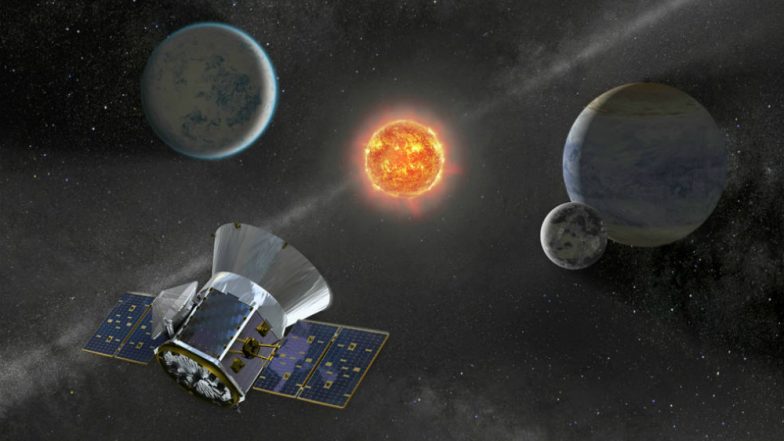
Space agency NASA is now on a new mission to search for new planets and explore the possibility of alien life. A new satellite called the Transiting Exoplanet Survey Satellite (TESS) will be sent with an aim of detecting outside planets will be sent on a SpaceX Falcon 9 rocket from Florida on April 16. According to IST, it will be launched around 4.02 a.m. on April 17 from the Cape Canaveral Air Force Station, as per NASA. TESS will spend about two years in the outside orbit and survey about 200,000 of the brightest stars near the Sun to search for planets, and the one that could support life.
This new satellite will help the future researchers a target to study on and do a consistent follow-up on them. The research will begin 60 days later after the launch, once it tests the instruments. This will include the possibility of them doing an in-depth research into alien life. In the first year of the observations, it will map the 13 sectors encompassing the southern sky, and the second year will map the 13 sectors of the northern sky.
Check NASA's tweet about TESS launch:
#Exoplanet hunter 🛰 @NASA_TESS will launch April 16 at 6:32 p.m. ET (2232 UTC) on @SpaceX’s #Falcon9 🚀 from #CCAFS here in Florida. It will be our SECOND of SIX LSP launches this year. The first being @NOAASatellites’ #GOESS which launched on March 4. pic.twitter.com/75vb7kWl20
— NASA_LSP (@NASA_LSP) April 11, 2018
The satellite has been developed by scientists at Massachusetts Institute of Technology (MIT) in the US. It is not more than a size of a refrigerator and has four wide-field cameras will give a field-of-view that covers 85 percent of our entire sky. In such a vast perspective, 26 sectors of the sky will be observed one by one. It will observe the movement of a certain planet, how it passes and also its brightness. NASA's mission Kepler spacecraft had used the same technique and spotted about 2,600 confirmed exoplanets.
“TESS is kind of like a scout,” said Natalia Guerrero, deputy manager of TESS Objects of Interest, “We’re on this scenic tour of the whole sky, and in some ways we have no idea what we will see. It’s like we’re making a treasure map,” Guerrero said. Scientists are hoping the satellite will reestablish contact within the first week. All its instruments and cameras will be turned on in this phase. While the engineers at NASA and MIT will calibrate the instruments and monitor the satellite’s trajectory and performance.
So if you have been eagerly interested about new planets discovery other than Earth and explore into a possibility of alien life, then TESS will be your favourite mission by NASA yet!
(The above story first appeared on LatestLY on Apr 12, 2018 02:07 PM IST. For more news and updates on politics, world, sports, entertainment and lifestyle, log on to our website latestly.com).