
Business News | Beyond the Scalpel: How AI and Robotics Are Rewriting the Rules of Joint Surgery in Odisha -Insight by Dr Dibya Singha Das
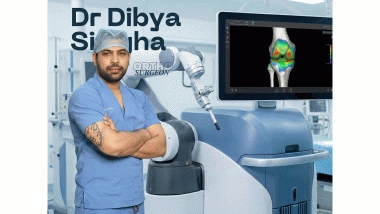
Get latest articles and stories on Business at LatestLY. Bhubaneshwar (Odisha) [India], December 19: For decades, the phrase "under the knife" has struck fear into the hearts of patients suffering from chronic joint pain. It conjures images of large incisions, long hospital stays, and painful recoveries. But as we move further into 2025, that narrative is becoming obsolete. Dr Dibya Singha a leading robotic surgeon in Odisha states that in operating theatres right here in Bhubaneswar, we are no longer just "surgeons" wielding scalpels; we are pilots of precision technology.

VMPL
Bhubaneshwar (Odisha) [India], December 19: For decades, the phrase "under the knife" has struck fear into the hearts of patients suffering from chronic joint pain. It conjures images of large incisions, long hospital stays, and painful recoveries. But as we move further into 2025, that narrative is becoming obsolete. Dr Dibya Singha a leading robotic surgeon in Odisha states that in operating theatres right here in Bhubaneswar, we are no longer just "surgeons" wielding scalpels; we are pilots of precision technology.
The "guesswork" of traditional orthopedics--eyeballing angles and relying on manual alignment guides--is being replaced by the sub-millimeter accuracy of Artificial Intelligence (AI) and Robotic-Assisted Surgery.
The End of "One Size Fits All"
Also Read | Smriti Mandhana Body Shamed For Wearing ‘Elegant’ White Floor-Length Gown; Fans Issue ‘Befitting Reply’.
The most profound innovation isn't just the robot; it is the Digital Twin technology we now utilize. Before a patient even enters the operating room, we use CT scans to create a 3D virtual model of their unique anatomy. This allows us to plan the surgery on a computer first, sizing the implant to the patient's specific bone structure. We are no longer fitting the patient to the implant; we are fitting the implant to the patient.
The Robotic Advantage: A Surgeon's "Guardian Angel"
There is a common misconception that the robot performs the surgery. It does not. The surgeon is always in control. The robotic arm acts as an intelligent guide--a "guardian angel" that physically prevents the surgeon from going outside the pre-planned boundaries. This haptic feedback ensures that we preserve vital ligaments, arteries, and healthy bone that traditional methods might sacrifice. This leads to less pain and faster healing.
Why This Matters for Odisha
Historically, patients from Odisha felt compelled to travel to metros like Delhi or Mumbai for advanced care. Today, Bhubaneswar has emerged as a center of excellence for Orthopedic Robotics. We are seeing patients walk--without support--within hours of surgery. We are seeing scars that are barely visible. We are seeing a return to active life in weeks, not months.
The Future is Biologic
Looking just over the horizon, the next leap is the convergence of Robotics and Orthobiologics. We are moving toward a future where we don't just replace joints; we regenerate them using a patient's own stem cells and platelet-rich plasma (PRP), delivered with robotic precision to the exact site of cartilage degeneration.
Pain is inevitable in life, but suffering is optional. With these innovations, we are not just fixing bones; we are restoring the freedom of movement, right here at home.
For further information please visit https://www.drdibya.com
(ADVERTORIAL DISCLAIMER: The above press release has been provided by VMPL. ANI will not be responsible in any way for the content of the same.)
(The above story is verified and authored by ANI staff, ANI is South Asia's leading multimedia news agency with over 100 bureaus in India, South Asia and across the globe. ANI brings the latest news on Politics and Current Affairs in India & around the World, Sports, Health, Fitness, Entertainment, & News. The views appearing in the above post do not reflect the opinions of LatestLY)