What Is Sudarshan Chakra? How Does It Work? All You Need To Know About IAF’s S-400 Air Defence Which Neutralised Pakistani Drones and Missiles
On the night of May 7–8, the Indian Air Force deployed S-400 ‘Sudarshan Chakra’ systems to intercept multiple Pakistani drones and missiles targeting 15 key military bases across northern and western India, including in Srinagar, Jammu, Amritsar, and Bhuj, showcasing India’s advanced air defence capabilities.

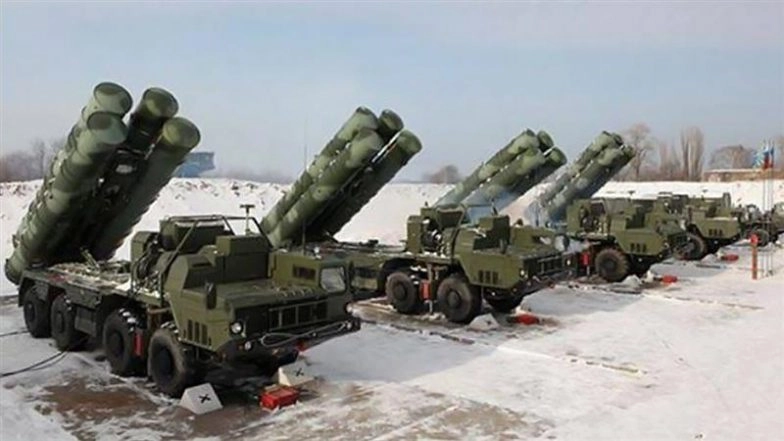
New Delhi, May 08: In a major demonstration of air defence capability, the Indian Air Force (IAF) successfully deployed the S-400 ‘Sudarshan Chakra’ missile systems to intercept and neutralise multiple Pakistani drones and missiles on the night of May 7–8. The aerial threats were reportedly aimed at 15 critical military installations across northern and western India, including bases in Srinagar, Jammu, Amritsar, Ludhiana, Bhatinda, Chandigarh, Phalodi, and Bhuj.
According to official sources, the S-400 units engaged and eliminated the incoming threats as part of India’s defensive operations, preventing potential damage to key infrastructure. The move underscores India’s growing reliance on cutting-edge missile defence systems to protect against high-speed aerial incursions by adversaries, particularly in light of increasing tensions with Pakistan and China. Operation Sindoor: India Neutralises Pakistani Drone, Missile Attacks; Targets Air Defence Systems.
What Is Sudarshan Chakra Air Defence System?
The S-400 Triumf, originally developed by Russia, is officially named ‘Sudarshan’ or ‘Sudarshan Chakra’ in Indian service. Inspired by Lord Krishna’s divine weapon, the name symbolizes the system’s precision and formidable power in defending against aerial threats, reinforcing its role as a critical shield in India’s air defence strategy. It is one of the world’s most advanced long-range surface-to-air missile (SAM) systems, developed by Russia’s Almaz Central Design Bureau. Known in NATO terminology as the SA-21 Growler, the system is capable of detecting and intercepting a variety of aerial threats including aircraft, drones, cruise missiles, and ballistic missiles. Each S-400 squadron includes 16 vehicles comprising launchers, radars, control centres, and support trucks. What Are Harop Drones? All About Israeli-Made Harpy Drone Which Has Become Key Asset in Arsenal of India and Several Countries.
India signed a deal worth approximately INR 35,000 crore in October 2018 to procure five squadrons of the S-400 from Russia. So far, three squadrons have been delivered and deployed across strategically vital regions—one near the Siliguri Corridor, another in the Pathankot area, and a third covering western India. The system has already emerged as a critical component of India’s defensive posture, designed to protect high-value military and civilian assets.
How Does It Work?
The S-400 functions through a highly coordinated process involving long-range surveillance radars, a command-and-control vehicle, and launch units. The system detects incoming threats up to 600 km away, calculates their trajectory, and launches appropriate missiles to intercept them. It can fire four types of missiles, the longest-range version capable of hitting targets up to 400 km away.
Unlike the US Patriot system which uses hit-to-kill interceptors, the S-400 relies on proximity detonation, offering a broader kill radius. Its area-denial capabilities make it effective not only for defence but also for constraining enemy air operations within their own territory.
With its recent deployment in live combat scenarios, the S-400 ‘Sudarshan Chakra’ has proven its value as a game-changing asset for India’s air defence strategy. As regional tensions persist, India’s continued investment in such advanced systems reflects its commitment to safeguarding sovereignty and maintaining aerial dominance.
(The above story first appeared on LatestLY on May 08, 2025 04:59 PM IST. For more news and updates on politics, world, sports, entertainment and lifestyle, log on to our website latestly.com).