Chandrayaan 2 Moon Landing: Vikram Lander to Touch Down on Moon's Surface Post Midnight; Here's What Will Happen After That
Chandrayaan-2 is India's first attempt at soft-landing on the surface of the moon. This mission will make India the fourth country after the US, Russia, and China to conduct a soft landing on the moon.

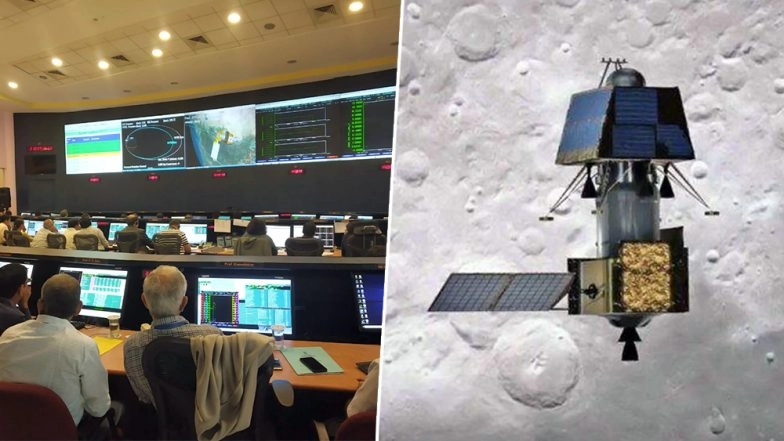
New Delhi, September 6: India and the world awaits the soft-landing of Chandrayaan-2 on the lunar surface. The scientists at the Indian Space Research Organisation (ISRO) are all over the moon as they await with bated breath for the country's ambitious lunar mission Chandrayaan-2’s historic landing on the moon during the early hours on Saturday. On Friday, ISRO has announced that the soft landing of Chandrayaan-2 lander (Vikram) on the lunar surface is scheduled between 1:30 am to 2:30 am on Saturday, followed by the rover (Pragyan) roll out between 5:30 am to 6:30 am.
The spacecraft's landing module ‘Vikram’ will begin its final descent to pull off a soft landing on the Moon's surface. With a successful mission on Saturday, it will be yet another feather in the cap for ISRO whose reputation in this field has grown exponentially. Chandrayaan 2 Landing: Ahead Of Touchdown, Poet-Diplomat Abhay K Pens Moon Anthem.
Reports inform that a total number of 38 soft landing attempts on the moon have been made by the space agencies so far. Out of the 38, the success rate has been 52 per cent.
Chandrayaan 2's Journey to The Moon

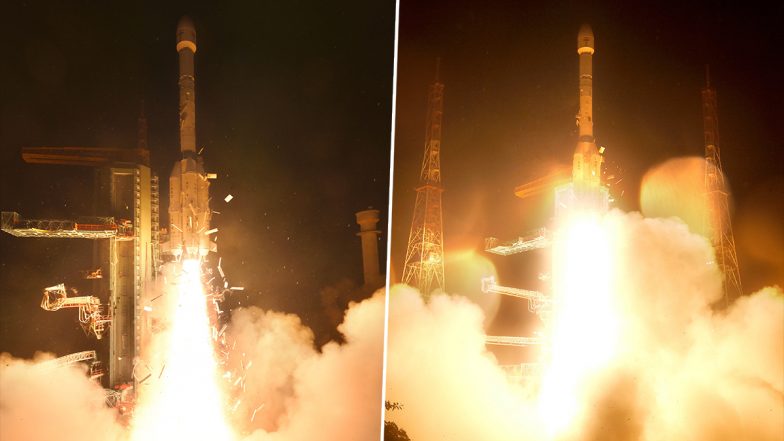
Chandrayaan 2 began its journey to the moon on August 14 after revolving around the Earth’s orbit for nearly 23 days. The mission took off from the Satish Dhawan Space Centre in Sriharikota on July 22. Chandrayaan-2 is India's first attempt at soft-landing on the surface of the moon. This mission will make India the fourth country after the US, Russia, and China to conduct a soft landing on the moon.
The Landing on Saturday

The historic landing of ‘Vikram’, which is Chandrayaan-2’s moon lander, will be carried out by at least eight onboard equipment in a coordinated manner. ‘Vikram’ with rover ‘Pragyan’ housed inside is scheduled for a powered-descent between 1 am and 2 am on Saturday. The touchdown is scheduled between 1.30 am and 2.30 am.
Last 15 Minutes of Landing Process Crucial
The last 15 minutes of the landing will be the most significant. The soft-landing will be very important because it is a very complex mechanism and involves various technologies. The Pragyan, which is is housed inside the Lander Vikram, will then roll out and deliver scientific payloads to conduct surface and subsurface experiments. With this, India will become the first country to land close to the lunar South Pole on its first attempt.
What will Happen After Landing
Chandrayaan-2's lander and rover will land in a high plain between two craters, Manzinus C and Simpelius N in the south pole of the Moon. This is a completely unexplored section. The rover (Pragyan) will be rolled out to carry out experiments on Lunar surface for a period of 1 Lunar day which is equal to 14 Earth days. The orbiter will continue its mission for a duration of one year.
The wheeled rover will move on the lunar surface and will perform on-site chemical analysis. It can relay data to Earth through the Chandrayaan-2 orbiter and lander, which will fly on the same launch. ISRO's aim is to improve the understanding of the Moon — discoveries that will benefit India and humanity as a whole.
The lunar exploration is essential to trace back the origin and evolution of the Moon. Also, Chandrayaan 2 will provide evidence for water molecules discovered by Chandrayaan-1. The prior findings require further studies on the extent of water molecule distribution on the surface, below the surface and in the tenuous lunar exosphere to address the origin of water on Moon.
The Lander (Vikram) and Rover (Pragyan)

The Lander (Vikram) weighing 1,471 kg is designed to execute a soft landing on the lunar surface. Meanwhile, the Rover (Pragyan), a 6-wheeled robotic vehicle, can travel up to 500 m and it leverages solar energy for its functioning. 'Pragyan' translates into 'wisdom' in Sanskrit. Vikram has the capability to communicate with Indian Deep Space Network (IDSN) at Byalalu near Bangalore, as well as with the orbiter and rover.
The Rover can only communicate with the Lander, which was separated from the orbiter on September 2 at 1.15 pm, by entering a descending orbit around the Moon.
Mission Life of Orbiter and Rover
The mission life of Orbiter will be one year whereas the mission life of lander (Vikram) and rover (Pragyan) will be one Lunar day which is equal to fourteen earth days.

Why did ISRO Choose South Pole for Landing and not North Pole
The South Pole of the Moon is interesting because of the lunar surface area here that remains in shadow is much larger than that at the North Pole. There is a possibility of the presence of water in permanently shadowed areas around it. In addition, South Pole region has craters that are cold traps and contain a fossil record of the early Solar System.
On Friday, ISRO posted a humorous message on Twitter featuring the spacecraft’s Lunar Orbiter extending good wishes to the Lander ahead of the historic moment. ”It was great travelling with you so far Vikram. Best of luck! I hope you reach the South Pole soon,” the Lunar Orbiter says while releasing Lander Vikram. To this Vikram replies, “It was quite the journey indeed! I’ll see you around – in the orbit.”
Watch Video: Chandrayaan 2 Landing on Moons Surface on Saturday
If successful, Chandrayaan-2 will be the second mission to soft-land near the lunar south pole region after the Chinese Chang'e 4 mission, which landed in that region on January 3, 2019. Chandrayaan 2 is an independent and indigenous mission as all technologies were created by Indian scientists. The Chandrayaan-2 mission is a point of national pride for India.
The mission will help ISRO gain a better understanding of the origin and evolution of the Moon by conducting detailed topographical studies, comprehensive mineralogical analyses, and a host of other experiments on the lunar surface.
(The above story first appeared on LatestLY on Sep 06, 2019 05:42 PM IST. For more news and updates on politics, world, sports, entertainment and lifestyle, log on to our website latestly.com).