











 Quickly
 Socially
 Trending
 Crypto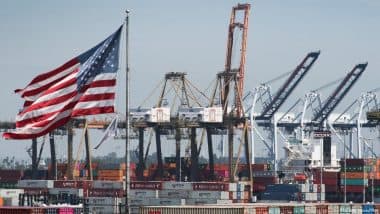
Facing a a global market crisis, the US President decided to pause tariffs on most countries for 90 days. He also raised the tariff rate for China to 125%. DW has more.Facing a global market meltdown, President Donald Trump abruptly backed down on his tariffs on most nations for 90 days.
He raised his tax rate on Chinese imports to 125% after Beijing said it would raise tariffs on US imports to 84%.
Also Read | Digital Arrest Case: Hyderabad Police Nab Uttar Pradesh Man Involved in 'Digital Arrest' Fraud.
Meanwhile, the European Union earlier agreed to go ahead with its retaliatory tariffs against the US, in response to a previously announced levy on steel and aluminum imports. However, Brussels has yet to respond to Trump's more recent announcement of a 20% on all imports from the EU.
Here are the latest developments from the fallout of the Trump tariffs on Wednesday, April 9:
Trump says he's backing down on most nations' tariffs for 90 days
Trump says he's backing down on most nations' tariffs for 90 days amid market meltdown. He however added that he's raising tariffs on China, even more.
Trump urges everyone to "be cool"
US President Donald Trump took to his Truth Social network to urge for calm, as countries, politicians and the stock market continue to react to his global tariffs.
"BE COOL! Everything is going to work out well. The USA will be bigger and better than ever before!" Trump posted.
The remark comes as more Republicans are going public with their worries about the effects of Trump's tariffs
"People are going to look at their 401(k) statements. They did vote for President Trump and they voted for me. ... I'm just trying to figure out if they are going to feel good about this," said Thom Tillis of North Carolina, one of seven Senate Republicans who have signed on to a bipartisan bill that would give Congress the authority to review and override new tariffs.
Republican Senator John Kennedy of Louisiana has publickly voiced similar concern.
"It's not fun. I don't like it. I like it when the market goes up," Kennedy told reporters. He said he wants to give Trump's gambit a chance, but that the president ought to do a better job of informing the public about his short-term goals.
But Trump has so far not listened to his detractors, sending a clear message to those who oppose tariffs in a speech he gave the during a dinner with fellow Republicans, where he mocked Republican concerns about tariffs and said the policy was working because now countries were "dying" to make a deal.
"I'm telling you, these countries are calling us up, kissing my ass," Trump said.
Germany is back: Merz's message to Trump
Responding to questions after they announced a deal to form a new German coalition government, leaders were asked what their message would be to US President Donald Trump in the wake of trade tariffs imposed on the EU.
"A key message to Donald Trump is, Germany is back on track," said chancellor-in-waiting Friedrich Merz, replying in English to a question from DW political editor Michaela Kuefner.
Merz said Germany was ready to strengthen its defense spending, something Trump has maintained is necessary, but also that Berlin wanted to improve its competitiveness from the point of view of trade.
"That is also the European Union. And Germany will be once again a very strong partner in the European Union and we will bring the European Union forward," he said.
"I fully agree," Social Democrat co-leader Lars Klingbeil briefly added in English.
In his response, CSU leader Markus Söder quipped, "I'll be back," referring to the catchphrase of Arnold Schwarzenegger's character in the Terminator movies.
Watch: Are US consumers ready to bear the costs of Trump's tariffs?
US treasury secretary hopeful for tariff negotiations with allies
US Treasury Secretary Scott Bessent said many countries were interested in striking fresh trade deals with Washington as the Trump administration's sweeping tariffs came into effect across the globe.
Speaking to a summit of the American Bankers Association in Washington on Wednesday, Bessent said Trump had already spoken with the leaders of Japan and South Korea, and US officials were set to meet with a delegation from Vietnam later in the day.
"I think ... at the end of the day that we can probably reach a deal with our allies, with the other countries that have been ... good military allies and not perfect economic allies. And then we can approach China as a group," he said.
Bessent said that aligning instead with China "would be cutting your own throat."
"They just keep producing and producing, dumping and dumping, and it's going somewhere," he said.
Bessent also accused China of escalating the situation after the US repeatedly introduced tariffs on Chinese imports that now total 104%.
"I think what a lot of people are missing here is that the levels that were put out last Wednesday are a ceiling if you don't retaliate," he said.
French trade minister calls for further negotiations
French Trade Minister Laurent Saint-Martin said that Europe wishes to avoid escalation in any trade war with the US.
"We never wanted tariffs to escalate. We believe that a tariff war is harmful for everyone," he told reporters during an official visit to Indonesia on Wednesday.
Saint-Martin called for further negotiations with Washington to find a solution.
"Under the aegis of the European Commission, we must continue the work of dialogue and negotiation with the US administration in order to achieve the most positive agenda possible," he said.
EU approves first retaliatory tariffs on US imports
The European Union agreed on Wednesday to go ahead with its own tariffs on US imports in retaliation for President Donald Trump's previously-announced levies on European steel and aluminum.
The EU tariffs will range from 15% to 25%, targeting US goods and commodities like soybeans, fruit, motorcycles, beauty products, clothes and dental floss. They will come into action next Tuesday.
"These countermeasures can be suspended at any time, should the US agree to a fair and balanced negotiated outcome," the European Commission said in a statement.
China files complaint with World Trade Organization
China lodged a new complaint with the World Trade Organization on Wednesday after the US further increased tariffs on Chinese imports to 104%.
"The situation has dangerously escalated... As one of the affected members, China expresses grave concern and firm opposition to this reckless move," the Chinese mission to the WTO said in a statement provided to Reuters.
The move was also reported by Chinese state media.
Trump urges companies to move operations to US
US President Donald Trump on Wednesday urged companies to relocate their operations to the US in order to avoid tariffs.
"This is a GREAT time to move your COMPANY into the United States of America," Trump said on his Truth Social platform.
He promised businesses "ZERO TARIFFS," and "no environmental delays."
China raises tariffs on US goods to 84%
China will raise its retaliatory tariff on US imports from 34% up to 84%, the Chinese Finance Ministry said on Wednesday afternoon.
The higher tariff will come into force on Thursday.
The United States exported $144.6 billion (€131.1 billion) in goods to China in 2024.
Agricultural products were a key commodity, with China buying more than half of US soybean exports last year. The US also exported fuel and oil products as well as electrical machinery.
US Treasury Secretary Scott Bessent said shortly afterward that China's new tariffs were "unfortunate."
Tariffs pummel global markets
Global markets reeled on Wednesday as Trump's tariffs kicked in.
European indexes opened down, with Germany's DAX losing 2.1%, Britain's FTSE 100 down 2% and the French CAC 40 down 2.1%.
More broadly, Europe's STOXX 600 fell nearly 3% in early trading.
Asia wrapped up a largely grim session on Wednesday, with China the one notable exception as investors reacted to a plan outlined by Beijing.
Japan's Nikkei 225 lost 3.9% by closing, but the greatest losses were felt in Taiwan, where the Taiex plunged 5.8%.
Chinese and Hong Kong stocks, however, closed higher on Wednesday. The blue-chip CSI300 Index opened down but then clawed back losses to end 1% higher, while Hong Kong's benchmark Hang Seng index also closed up 0.7%.
"Risk assets have bounced on a white paper that suggests China is open to dialogue — though does not confirm US/China negotiations are under way and means further headline noise is inevitable," Citi analysts said in a note.
The widespread volatility in Europe and Asia followed an even greater whipsaw in US markets on Tuesday.
That session saw the benchmark S&P 500 climb by more than 4% during the day amid investors' hopes that negotiations could limit the damages caused by tariffs.
But the index ultimately closed down 1.6% — the first time since 1978 that it recorded such a dramatic reversal during a single session.
China vows to 'fight' as hefty US tariffs kick in
China declared its firm resolve to "fight till the end" in a trade war with Washington, after the United States' hefty 104% tariffs on Chinese goods came into effect on Wednesday.
"With firm will and abundant means, China will resolutely take countermeasures and fight till the end if the United States insists on further escalating economic and trade restrictive measures," Beijing's Commerce Ministry said in a statement reported by Xinhua news agency.
At the same time, the statement added that there are "no winners in a trade war."
"China does not want one, but the government will never allow the legitimate rights and interests of the Chinese people to be harmed or taken away."
With tariffs over 100%, China is by far the country hardest hit by the Trump administration's tariffs. Trump nearly doubled duties on Chinese imports, which had been set at 54% last week, in response to Chinese counter-tariffs of 34% on US goods levied last week.
Foreign Ministry spokesperson Lin Jian has accused the US of abusing "tariffs to pressure China," condemning what he described as American "bullying."
Meanwhile, China's top leaders are reportedly meeting as early as Wednesday to prepare economic support measures to boost the economy and stabilize the capital markets, according to Reuters.
At the same time, a White Paper on trade with the US released on Wednesday by China said that economic friction between the two nations is normal, insisting that Beijing remains open to dialogue, Xinhua reported.
EU response to Trump's tariffs: a delicate balance
European Union trade ministers met on Monday in Luxembourg, weeks ahead of schedule, to address the fallout from the tariffs imposed by the United States.
The emergency meeting followed US President Donald Trump's announcement of sweeping 20% tariffs on nearly all EU exports, impacting goods valued over €532 billion ($585 billion) in 2024.
For the leaders the message was clear from the start: Europe will respond with both unity and determination, with Germany's outgoing Economic Minister Robert Habeck underscoring the need for European solidarity.
A proposed €25.7 billion tariff package on US goods will be voted on Wednesday in response to the first round of US tariffs on aluminum and steel back in March.
Read more here.
Are Trump's tariffs 'reciprocal?'
US President Donald Trump and his economic team have repeatedly insisted that the reciprocal tariffs are simply returning the same barriers that US exporters face when selling to the same countries.
However, a range of economists, banks and financial institutions have pointed out that the tariffs are not reciprocal and that the formula Trump's team used to calculate them makes little economic sense.
Doug Irwin, a nonresident senior fellow at the Peterson Institute for International Economics and a renowned global trade expert, also says the tariffs are clearly not reciprocal for a number of reasons.
He told DW that a key point was that the formula used by the White House did not even take into account the levels of tariffs imposed by other countries, and simply took America's trade deficit in goods with each country and then divided it by the amount of goods imported into the US from that country.
Data from the World Trade Organization (WTO) backs up the arguments made by several economists that Trump's allegedly reciprocal tariffs will actually be far higher than most of those levied in the opposite direction.
Bill Reinsch, a senior economics adviser with the Center for Strategic and International Studies (CSIS), told DW that for more than 40 years, Trump has spoken about how he believes the US is being "ripped off" on global trade. He believes Trump genuinely wants to restructure global trade, which, however, has turned into a "revenge thing."
"The problem with it is he really only has one metric, which is the bilateral trade deficit, and he really only has one tool, which is tariffs," said Reinsch.
Read the full story here.
Trump's sweeping tariffs come into effect
US President Donald Trump's sweeping tariffs came into effect on Wednesday, including a massive 104% duty on Chinese goods.
The new levies also targeted imports from allies, such as the European Union and Japan, sparking fears of a global trade war, with Trump saying the target countries are "ripping off" the US.
The customized rates for nearly 60 economies supersede the 10% baseline duties that took effect over the weekend.
China, the main target, faces the heaviest impact.
In tit-for-tat tariff impositions, China announced last Friday 34% in additional tariffs on all goods imported from the US, starting Thursday, matching Trump imposing new levies of 34% on China.
Trump responded by adding another 50% duty after China’s countermeasures, slapping a total of 104% duties on Chinese goods.
The Trump administration says nations like Japan, South Korea, and Vietnam are open to negotiations, with Trump telling fellow Republicans at a dinner on Tuesday evening that countries were "dying" to make a deal.
"I'm telling you, these countries are calling us up kissing my ass," he said.
The tariffs have rattled markets — wiping nearly $6 trillion off the S&P 500.
On Wednesday, Asian markets opened down again while China's offshore yuan fell to an all-time low against the US dollar. Oil prices also slumped.
Meanwhile, Canada said that its tariffs on certain US auto imports will come into force Wednesday.
(The above story first appeared on LatestLY on Apr 09, 2025 11:20 PM IST. For more news and updates on politics, world, sports, entertainment and lifestyle, log on to our website latestly.com).
 Share Now
 Google Trends



 Live Bot