What Are the Real Impacts of Melting Glaciers?
Glaciers are the planet's frozen water banks.

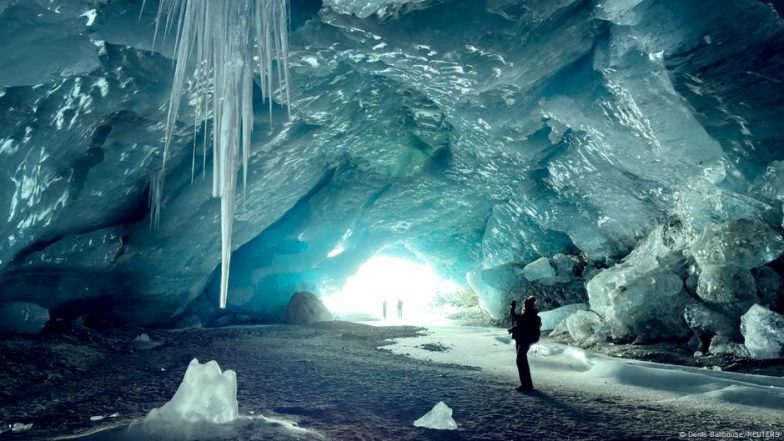
Glaciers are the planet's frozen water banks. They sustain water supply, ecosystems and even cultural traditions. But many of these sprawling beds of ice are melting. Why does that matter?The collapse of a glacier in the Swiss Alps this week has underscored the impacts of a warming world on the ice-packed parts of planet Earth.
When the melting Birch Glacier on crumbled on Wednesday, it engulfed the picturesque village of Blatten in the country's southern Wallis region. A mound of debris has clogged the path of the Lonza River, increasing the risk of flooding.Also Read | Sports News | Jasprit Bumrah Opens Up on Managing Formats, Olympic Dreams, and Taking Life One Day at a Time.
Glaciers and ice sheets store about 70% of the world's freshwater reserves. High-altitude regions are often dubbed the world's "water towers" because they gradually release meltwater in the summer, sustaining towns and farms downstream. Also Read | Sports News | Bhatia Makes Fine Start with 70, Lies Tied 7th at Memorial.
Two billion people globally rely on glacial melt for their day-to-day water needs, researchers say. Yet, as the world gets hotter, the ice is thawing.
Glaciers around the world are now melting at twice the rate measured just two decades ago. Between 2000 and 2023, they lost an ice mass equivalent to 46,000 Great Pyramids of Giza.
And this is impacting communities worldwide. Some regions are left with too little water while others struggle with too much.
Glaciers as crucial freshwater resource
The residents of the small western Peruvian town of Huaraz draw almost 20% of their annual water supply from melting ice. But Andean glaciers are thawing even faster than elsewhere.
This poses a risk of flooding. In a decade-long lawsuit, one resident of Huaraz sued a German energy company over the potential risk to his home from a mountain lake that is filling with melt water at rapid rates.
Meltwater damages infrastructure and makes mountains unstable
It is not only in Peru that huge glacial lakes form when glaciers thaw. When they become too full, deadly floods can wash away buildings, bridges and wipe out fertile land, like in Pakistan, where a glacial lake burst in October 2023.
That same month in neighboring India, a lake of melted ice overflowed and killed 179 people. Scientists estimate that globally, at least 15 million people are vulnerable to sudden flooding from thawing ice, most of them living in India and Pakistan. Since 1990, the volume of water in mountain lakes has increased by around 50%.
The collapse of the Birch glacier in Switzerland caused a landslide of rock and ice that covered most of the 300-strong village of Blatten in mud. Though residents had been evacuated as a precaution, one man is missing in what scientists call the latest dramatic example of climate change's impact on the Alps. There are also now fears that a nearby river will be blocked causing flooding in the region.
Dwindling water supply for agriculture and electricity generation
As glaciers shrink, they eventually reach a threshold — known as peak water — at which runoff declines. As a result, less melt water flows downstream with potentially far-reaching consequences.
Reduced water supply has forced local farmers, who traditionally grew corn and wheat, to change both their crops and water management. Some communities in the Andes have now switched to growing a bitter potato variety that is more resilient to drought.
Unstable water supply is also stalling electricity production. In Chile, 27% of power is generated by hydroelectric dams which critically depend on meltwater. In 2021, the Alto Maipo plant was shut down due to dwindling flow.
Melting ice sheets increase sea levels
It’s not only glaciers in high altitudes that are melting — but also those in the ocean, like Thwaites Glacier in Western Antarctica. This frosty giant is the size of the US state of Florida and has been deemed "very unstable." Scientists say it is thawing on all sides.
The melting of sea ice crucially contributes to rising sea levels. Thwaites Glacier has been dubbed "doomsday glacier" for its potential impact on what some researchers call 'abrupt' sea level rise.
In the last 25 years alone, melting glaciers have caused global sea levels to rise almost 2cm (0.7 inches). This might not seem like much, but low-lying islands like Fiji and Vanuatu in the Pacific are at risk of disappearing under the waves. In addition more than 1 billion people in megacities like Jakarta, Mumbai, Lagos, Manila live within ten kilometers from the coast and protective dykes are only a temporary solution as sea levels continue to rise.
Ice traditions under threat
Glaciers also hold spiritual and cultural significance. Every year, tens of thousands of pilgrims gather at one of Peru’s most sacred glaciers, the Colquepunco, for a religious festival. In the past, ice blocks were carved from the glacier and carried down to local communities who believed in their healing properties. But as the glacier vanishes, this ancient tradition has come under threat.
Less snowfall for Alpine ski resorts
The Presena glacier in Italy, a popular destination for skiers, has reportedly lost a third of its volume since 1990. And natural snow in the European Alps is expected to decline by 42% by the end of the century. Scientists estimate that many ski resorts worldwide won’t be profitable anymore in the future.
Warning systems and artificial glaciers can help
Locals can adapt to some of these dangers. In the Pakistan village of Hassanabad, an early warning system has been installed to monitor activity at the nearby Shisper glacier. Should there be a need for a warning, it can be communicated through external speakers in the village.
In the neighboring Ladakh region, researchers are experimenting with growing artificial glaciers that can mitigate water shortage in summer to meet this challenge.
But these strategies can only work up to a point. Scientist say the best way to tackle receding glaciers is to slow the rising temperatures that are heating the Earth.
Edited by: Anke Rasper
(The above story first appeared on LatestLY on May 30, 2025 12:40 PM IST. For more news and updates on politics, world, sports, entertainment and lifestyle, log on to our website latestly.com).