Rare Video of Extinct Thylacine Released Online, Australia’s National Archives Shares Footage of Tasmanian Tiger from 1935!
A video shot in 1935 of the last-known thylacine, or Tasmanian tiger, has been released by the NFSA. In the video, Thylacine named Benjamin can be seen pacing in its enclosure at Beaumaris Zoo in Hobart, Tasmania. It is one of the only two places where a thylacine was held in captivity. The other one was a zoo in London.

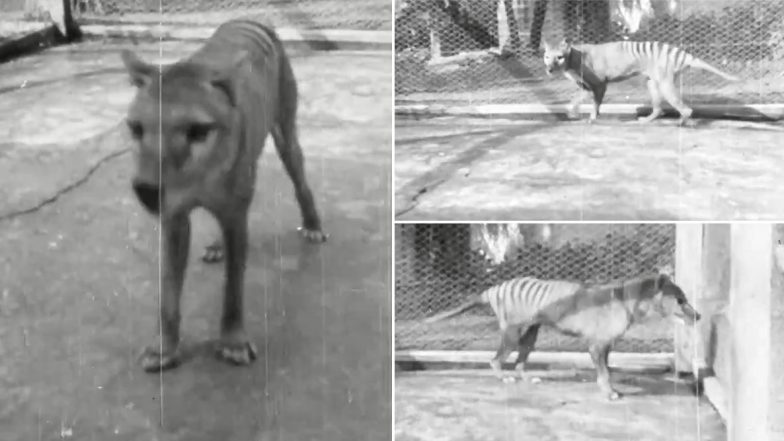
A video shot in 1935 of the last-known thylacine, or Tasmanian tiger, has been released by the National Film and Sound Archive of Australia (NFSA). The Thylacine was one of the largest known carnivorous marsupials native to Tasmania, New Guinea, and the Australian mainland. Its distinctive striped lower back had earned it the name Tasmanian tiger. In the video, Thylacine named Benjamin can be seen pacing in its enclosure at Beaumaris Zoo in Hobart, Tasmania. It is one of the only two places where a thylacine was held in captivity. The other one was a zoo in London. 'Rare' Two-Headed Wolf Snake Spotted in Odisha But It's Not The Only One! View Pics and Videos of Serpents With Two Heads From Around The World
18 months after this film was taken, the only known thylacine in captivity died on September 7, 1936, thus causing the extinction of the species. NFSA took to Twitter sharing the video with the caption, "We have released 21-second newsreel clip featuring the last known images of the extinct Thylacine, filmed in 1935, has been digitised in 4K and released." Madagascar Pochard, World's Rarest Bird Thought to Extinct for a Decade Comes Back to Natural Habitat With the Help of Rescue Teams.
Rare Footage Of Last-Known Tasmanian Tiger:
We have released 21-second newsreel clip featuring the last known images of the extinct Thylacine, filmed in 1935, has been digitised in 4K and released.
Be sure to check out the footage of this beautiful marsupial. #NFSAOpenOnline #TasmanianTigerhttps://t.co/s3JSAnmFck pic.twitter.com/FSRYXCTTMy
— NFSA -National Film and Sound Archive of Australia (@NFSAonline) May 19, 2020
The film's narrator can be heard saying in the footage, "This is the only one in captivity in the world. The Tasmanian tiger is now very rare, being forced out of its natural habitat by the march of civilisation." The footage was extracted from a 1935 travelogue called 'Tasmania the Wonderland'. NFSA Curator Simon Smith in a press release said, "The scarcity of thylacine footage makes every second of moving image really precious. We're very excited to make this newly-digitised footage available to everyone online."
According to The Australian Museum, thylacines were once seen throughout continental Australia but became extinct on the mainland around 2,000 years ago. Its population was then confined to the island of Tasmania. The museum said, "Its decline and extinction in Tasmania was probably hastened by the introduction of dogs, but appears mainly due to direct human persecution as an alleged pest."
(The above story first appeared on LatestLY on May 20, 2020 07:35 PM IST. For more news and updates on politics, world, sports, entertainment and lifestyle, log on to our website latestly.com).