Mosquitoes: The Most Dangerous Animals in the World?
Malaria, dengue, Zika virus, and West Nile fever are all diseases that can be spread by mosquitoes.

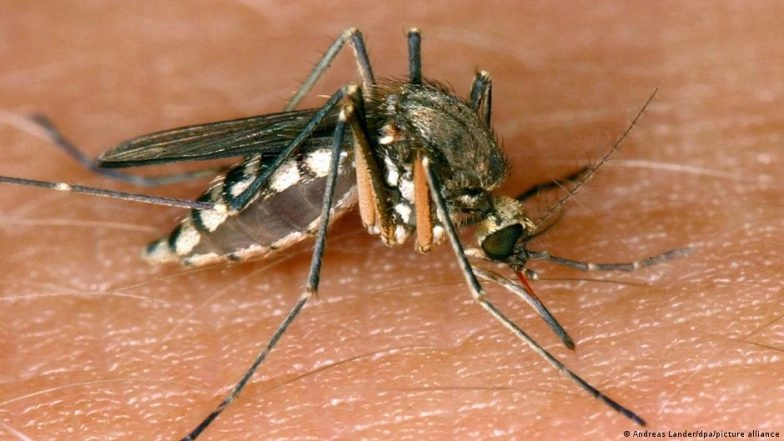
Malaria, dengue, Zika virus, and West Nile fever are all diseases that can be spread by mosquitoes. Hundreds of thousands of people die from such infections every year. David Hancock was almost one of them.It all started one day in June 2007, with a sudden fever and severe vomiting, said David Hancock. He should have gone to hospital, immediately. But he didn't — he thought: If this is a common infection, I'll get over it.
Also Read | New Strain of Mpox Virus: What You Need to Know.
Then he realized it wasn't a common infection.
Also Read | Cold Moon 2025: Last Supermoon of the Year To Grace Night Sky Today; Know if It Will Be Visible in India.
But it still took 10 days for doctors to make a reliable diagnosis. 10 days during which the then 49-year-old fell into a coma and suffered heart failure — multiple times. His lungs filled with fluid, and his brain became inflamed.
"I was on the other side, with one foot in the other world, so to speak," said David of the experience, when we spoke in 2025.
David had contracted West Nile virus from a mosquito bite on his very own doorstep in Glendale, a city near Phoenix, in the US state of Arizona.
A perfect pair: Mosquitoes and West Nile fever
Unlike malaria, dengue, yellow yellow fever or the Zika virus, West Nile virus (WNV) is not transmitted by invasive mosquitoes that have traveled north from the Tropics. WNV is mainly transmitted by native mosquitoes of the genus Culex.
But WNV does originate from the Tropics. It was first detected in 1937 in the West Nile region of northern Uganda and named after that place where it was found.
Migratory birds then brought WNV to Europe and the US, where it was first recorded in 1999. Today, it is the main cause of mosquito-borne diseases in the US.
Tropical WNV is transmitted by Culex pipiens, a common mosquito. It is a European and North American native and a particularly good "vector" for virus.
If, for example, a mosquito bites a bird that is infected with WNV, and the mosquito gets infected itself, the virus will replicate in the mosquito, and the mosquito will then pass on the virus to another animal when it takes a blood meal. That can be another bird or a horse. Or a human, as it was in David's case.
WNV infection can go unnoticed — it is an asymptomatic infection — but an average of 1,300 people in the USA fall seriously ill with WNV every year. And 130 of them die.
Irony of David's fate: His brother Bob is a mosquito researcher
In addition to fever and vomiting, David eventually became unable to swallow. Finally, his wife, Teri, resolved to take him to hospital. Big mistake.
"What we should have done is call an ambulance and have them take me, so I would have moved to the head of the triage line, but I went to the emergency room, where I waited hours and hours and hours to be admitted, and it almost cost me my life," said David.
At some point, Teri went home to feed their dog. When she returned to the hospital, she learned that David's heart had stopped twice, and that he was now on a ventilator in intensive care.
David's fever was so high that the temperature in the room was chilling. His doctors expected him to die.
So, Teri got the whole family together: her parents, David's parents, and his brother Bob.
Bob Hancock is a biologist and — ironically — has been researching the behavior of mosquitoes for decades.
"When the news got around that David had contracted West Nile, everyone asked: 'Are you sure it's David?'" said Bob. Because, after all, it was Bob who was always surrounded by mosquitoes in a South American jungle.
"I do really admire my subject," said Bob. "I don't study [mosquitoes] because I want to destroy them. I'm interested in them."
Climate change: Better conditions for mosquitoes and viruses to thrive
Most mosquito bites are harmless. It's only the clinical cases that get counted — "that is, when someone has to go to the doctor or hospital," said Bob — or if an infection becomes fatal. Those are the cases we know about. The number of unreported cases — of those people who become infected without realizing it — is probably quite high. Those cases don't get recorded.
But the dangers of infection are very real. David's illness left a trauma for both him and his wife, Teri. Teri still cries when she recalls the days she thought her husband was about to die.
Bob's life also changed after his brother's illness.
"I would have been happy, just to be this fun-loving mosquito lover, who was only interested in jungle mosquitoes that fly around and do cool things," he said.
But since his brother's infection, Bob's interests have turned to mosquito-borne disease transmission. "I've matured into the medical entomologist I am today," he told DW.
These days, Bob keeps a close eye on developments in the US. Climate change is providing tropical mosquitoes and viruses with ever better living conditions in northern climes now.
For instance, it will have taken 10 years for the Aedes species of mosquito to migrate from Southern California to San Francisco — a distance of about 643 kilometers (400 miles).
Aedes mosquitoes, which originally come from the tropics, are potent carriers of disease, including dengue, yellow fever and Zika.
"There's no reason for us to believe that the mosquitoes are going to come and the disease is not," said Bob.
Mosquitoes are not dangerous, viruses are
David's life has changed since his infection.
When he woke up from his coma, he could neither breathe nor speak on his own. He was emaciated and couldn't walk. It took him nine months before he could walk again. He is still unable to swallow without help.
Teri says David has become introverted, unlike the man she married. He is different. They assume the virus left damage in David's brain.
But one thing hasn't changed: David still gets bitten by mosquitoes. The only thing that helps is mosquito spray, and lots of it.
"I absolutely hate [mosquitoes]," said David. And Teri hates them, too. Who can blame the couple?
And what about Bob?
"I still love mosquitoes. They're just trying to get a meal and raise a family," he said. "I do hate the virus, though. I mean, I could hate the birds, too, right? Because the mosquito that gave it to my brother got it from a bird."
This article was translated from the original German-language version.
(The above story first appeared on LatestLY on Dec 10, 2025 07:00 PM IST. For more news and updates on politics, world, sports, entertainment and lifestyle, log on to our website latestly.com).